NQ 1M Direction Strength Meter (Bull + Bear) [v6]NQ 1M Direction Strength Meter (Bull + Bear)
By: StanTheTradingMan
License: Mozilla Public License 2.0 (MPL-2.0)
Overview
NQ 1M Direction Strength Meter is a compact, real-time bull vs bear strength engine designed to answer one question clearly:
“Who is in control right now — buyers or sellers — and how strong is that control?”
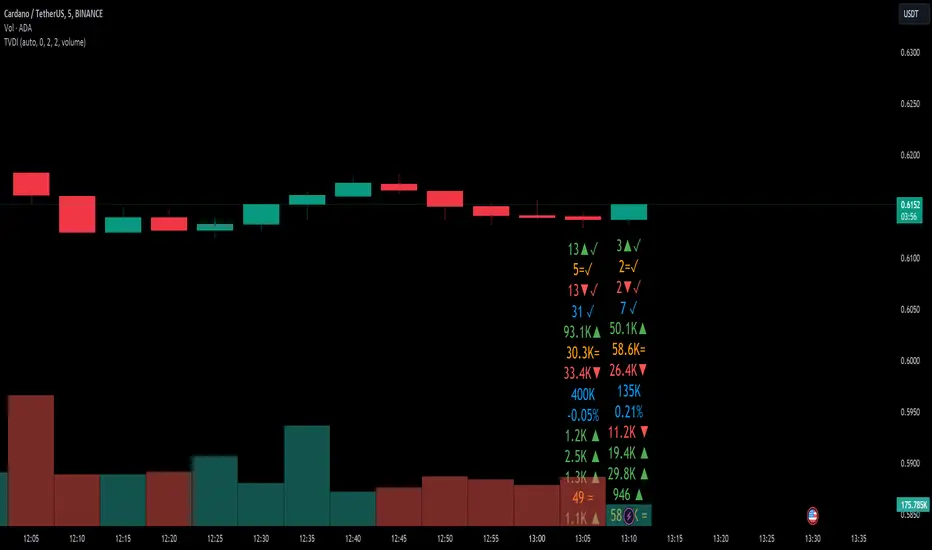
Instead of printing noisy buy/sell spam, this tool continuously scores Bull Strength and Bear Strength on a 0–100 scale , then displays a Net (Bull − Bear) histogram for quick bias confirmation. It’s tuned for NQ 1-minute action but works on any symbol/timeframe.
What You Get
✅ Bull Strength (0–100) line
✅ Bear Strength (0–100) line
✅ Net histogram = Bull − Bear (dominance / bias)
✅ Optional background tint when bull/bear becomes “strong”
✅ Flip triangles + alerts when strength crosses the “Strong” threshold
✅ Optional RTH-only scoring (0930–1600) to reduce overnight noise
How the Score Works (Simple + Transparent)
Each side (bull/bear) is built from five components, blended into a single 0–100 score:
Directional Slope (ATR-normalized)
Uses EMA slope strength and maps it smoothly (no harsh jumps).
Bull score rises when slope is positive; Bear score rises when slope is negative.
Level / Trend Alignment
Bull points for: above VWAP (optional), above EMA mid, bullish EMA stack (fast ≥ mid ≥ slow)
Bear points for: below VWAP (optional), below EMA mid, bearish EMA stack (fast ≤ mid ≤ slow)
Volume Participation (shared)
Scores higher when current volume meaningfully exceeds its moving average.
Helps avoid “weak moves” that drift without participation.
Pullback Quality (directional)
Bull prefers shallow pullbacks from recent highs.
Bear prefers shallow bounces from recent lows.
Uses ATR to standardize “how bad” a counter-move is.
Momentum (RSI fast)
Bull benefits from higher RSI, Bear benefits from lower RSI (fast reaction).
Default weighting (blended):
Slope 32% • Volume 26% • Pullback Quality 18% • Level/Stack 16% • RSI 8%
How to Use It (Practical Read)
Think of it like a “directional engine gauge,” not a stand-alone entry system.
Bull-favoring conditions:
Bull Strength climbs and holds above 50
Bull Strength pushes above 70 (Strong)
Bear Strength stays suppressed (often below 50 )
Net histogram positive and expanding
Bear-favoring conditions:
Bear Strength climbs and holds above 50
Bear Strength pushes above 70 (Strong)
Bull Strength stays suppressed
Net histogram negative and expanding
Chop / no-trade warning:
Bull and Bear both hovering near mid-range (around 40–60)
Net histogram flipping frequently
Strong threshold rarely holds after being crossed
Signals & Alerts
This script includes two clean “state change” triggers:
Bull turns STRONG when Bull Strength crosses above the Strong Threshold (default 70)
Bear turns STRONG when Bear Strength crosses above the Strong Threshold (default 70)
You can create TradingView alerts using:
“BULL STRONG”
“BEAR STRONG”
These are intended as momentum/confirmation notifications , not guaranteed entries.
Recommended Settings (for NQ 1M)
Defaults are already tuned for fast index futures behavior:
EMA Fast/Mid/Slow: 8 / 21 / 50
RSI Length: 7 (fast)
ATR: 14
Volume MA: 20
Lookback (pullback quality): 60
Smoothing: 5
Strong Threshold: 70
Weak Threshold: 50
VWAP scoring: ON (recommended intraday)
RTH filter: ON if you want cleaner signal integrity (less overnight noise)
Notes / Limitations
This is a strength meter, not a full strategy. Use it alongside structure (levels, VWAP, OR, liquidity, etc.).
Volume behavior varies by market/session; RTH filtering can dramatically improve signal quality for index futures.
Like any oscillator-style tool, it can lag slightly due to smoothing—this is intentional to reduce flicker and false flips.
Disclaimer
This indicator is for educational and informational purposes only and does not constitute financial advice. Trading involves substantial risk, and you are responsible for your own decisions, risk management, and execution.
Pine Script®指標