Swing Structure Bands [ChartPrime]⯁ OVERVIEW
Swing Structure Bands is a structure-based trend and reaction indicator that builds adaptive price bands directly from swing highs and swing lows.
Instead of using fixed-length moving averages, the bands dynamically adjust their length based on how long price has been forming higher highs or lower lows, allowing the indicator to naturally align with real market structure.
This makes the tool especially effective for identifying swing-based support and resistance, trend continuation zones, and exhaustion reactions.
⯁ CORE CONCEPT
The indicator continuously tracks:
The most recent swing high and swing low over a configurable swing window.
How long price has been developing since each swing point.
Dynamic moving averages whose length grows with the swing itself.
As long as price respects the current swing direction, the bands extend and adapt.
When structure breaks, the system resets and starts forming new swing-based bands.
⯁ SWING DETECTION LOGIC
A Swing High is detected when price forms a local maximum relative to the swing lookback.
A Swing Low is detected when price forms a local minimum relative to the swing lookback.
Direction flips when price transitions from forming highs to forming lows, or vice versa.
Each confirmed swing is marked on the chart, giving clear structural context.
⯁ ADAPTIVE BAND CONSTRUCTION
Upper bands are derived from swing highs.
Lower bands are derived from swing lows.
Band length dynamically increases as the swing develops.
Multiple MA types can be used (SMA, EMA, SMMA/RMA, WMA, VWMA).
ATR is applied as an offset to create upper and lower envelopes around each band, forming a volatility-aware structure channel.
⯁ VOLATILITY FILTERING
If the band moves too aggressively relative to ATR, it is temporarily disabled.
This prevents unstable or noisy bands during sudden expansions.
Bands only remain active when price structure is stable.
This logic keeps the indicator focused on meaningful swings rather than short-term spikes.
⯁ REACTION & SIGNAL LOGIC
Sell signals appear when price crosses down from the upper swing band after sufficient stabilization.
Buy signals appear when price crosses up from the lower swing band after sufficient stabilization.
Cooldown logic prevents signal clustering.
Signals are designed as structure reactions , not momentum breakouts.
⯁ VISUAL STRUCTURE CLARITY
Separate bullish and bearish bands with customizable colors.
Optional band envelopes for visual depth.
Clear swing labels marking structural turning points.
Diamond markers highlight reaction zones.
The visualization emphasizes where price reacts to structure rather than where it accelerates.
⯁ HOW TO USE
Use upper bands as dynamic resistance during bearish or corrective phases.
Use lower bands as dynamic support during bullish phases.
Combine band reactions with higher-timeframe trend direction.
Look for confirmations near bands rather than mid-range entries.
The indicator works best as a structure framework rather than a standalone signal generator.
⯁ IDEAL MARKET CONDITIONS
Trending markets with clear swing development.
Markets transitioning from impulse to correction.
Crypto, forex, indices, and liquid stocks.
⯁ CONCLUSION
Swing Structure Bands offers a structurally grounded alternative to traditional moving average channels.
By anchoring bands to real swing behavior and adapting dynamically over time, it provides traders with a clearer view of where price is reacting, pausing, or potentially reversing within the broader market structure.
Trend-structure

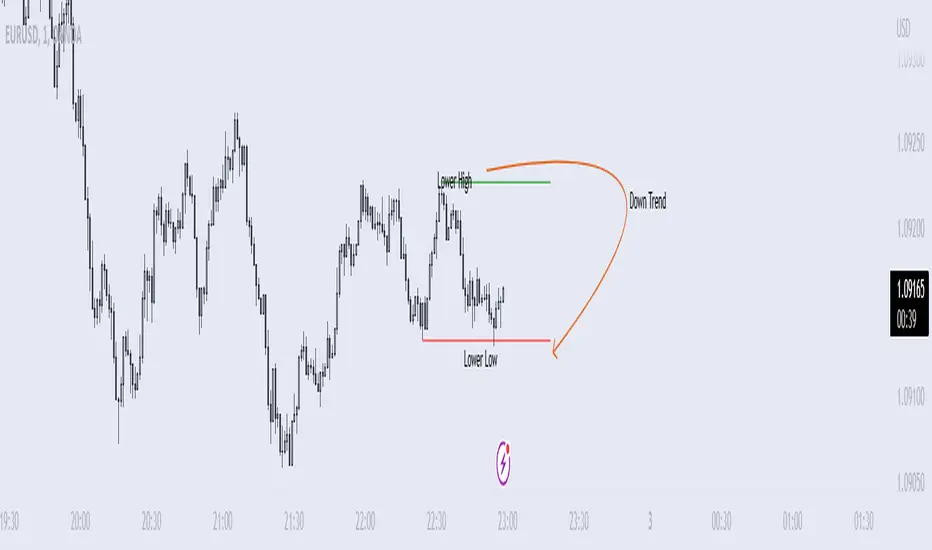
Price Swing Detection - Smart Money ConceptSince my own style is Smart Money Concept and these days I have seen a lot of my friends who are having trouble identifying structures for their indicators and strategies. I wrote this code so they could use it in their strategy . In fact, this type of structure, as one of the strongest technical structures, can increase the success of your strategy according to your personalization.
The script detects swings (i.e. significant highs and lows) in a financial instrument's price action over a specified period. The user can set the lookback period (number of candles to consider) and the colors of the lines representing bullish and bearish trends.
The script has two functions: detectSwing and pivot high. The detectSwing function calculates the swing highs and lows for the specified number of candles. The function uses the ta.highest and ta.lowest functions to find the highest and lowest prices, respectively, over the lookback period. The function also determines the swing state (high or low) of the current candle and returns the calculated swing values.
The pivot high function calculates the pivot high, which is an important step in detecting bullish structures in the market. If a new top (i.e. swing high) is found, the script updates the pivot high values and creates a line from the recent top to the last bar. The script also updates the trailing maximum values, which are used to extend the top extension line.
For Strategy :
The variable "trendDirection" in the code is used to keep track of the trend state, either bullish (up trend) or bearish (down trend), in the market. The variable is initialized to 0 which represents a downtrend. The value of this variable is updated later in the code based on the calculations of swing highs and lows, pivot crosses, and the trailing maximum. If a bullish structure is detected, the value of "trendDirection" is set to 1, indicating an uptrend.