Volume Anomaly Reversal DetectionVolume Anomaly Reversal Detection (VARD System)
🎯 What This Indicator Does
This indicator identifies potential trend reversals by detecting abnormal volume activity that often precedes significant price movements. It combines volume anomaly detection with dynamic trend analysis to generate actionable BUY/SELL signals.
📊 Core Concept & Methodology
Volume Anomaly Detection
The indicator analyzes directional volume (buying vs selling pressure) from a lower timeframe and calculates Z-scores to identify statistically significant volume spikes.
Z-Score Formula:
Z = (Current Volume - Average Volume) / Standard Deviation
When volume exceeds the threshold (default: 3 standard deviations above mean), it signals unusual market activity - often caused by forced liquidations or capitulation.
Dynamic Trend Filter
A custom trend-following algorithm based on ATR (Average True Range) bands determines the current market direction:
Price above lower band = Uptrend
Price below upper band = Downtrend
Signal Logic
Volume anomaly detected during an existing trend
Trend reversal confirmed within the confirmation window
Signal generated = BUY or SELL label appears
⚙️ Settings Explained
SettingDefaultDescriptionAnalysis Timeframe15minLower timeframe for volume samplingStatistical Lookback200Bars used for Z-score calculationAnomaly Sensitivity3.0Z-score threshold (lower = more signals)Confirmation Window50Max bars between anomaly and trend flipATR Multiplier2.0Trend band widthTrend Period10ATR calculation length
📖 How To Use
Entry Signals
BUY: Green label appears below bar - consider long positions
SELL: Red label appears above bar - consider short positions
Volume Anomaly Markers (⬥)
Small diamonds indicate detected volume spikes
These are early warnings before confirmed signals
Useful for anticipating potential reversals
Trend Bands
Colored zones show active signal direction
Stay with the trend until opposite signal appears
Best Practices
Confirm with price action - Look for support/resistance levels
Use appropriate timeframes - Works on all timeframes, but 1H-4H recommended
Manage risk - Always use stop losses
Avoid ranging markets - Best in trending/volatile conditions
⚠️ Important Notes
No indicator is perfect - Use as part of a complete trading strategy
Volume data required - Will show warning if volume unavailable
Not financial advice - Always do your own research
🔔 Alerts Available
BUY Signal Confirmed
SELL Signal Confirmed
Volume Anomaly (Buy Setup)
Volume Anomaly (Sell Setup)
Algo

Institutional Zone Detector [Scalping-Algo]█ OVERVIEW
The Institutional Zone Detector identifies key supply and demand zones where large market participants (institutions, banks, hedge funds) have likely placed significant orders. These zones often act as powerful support and resistance levels, making them strategic areas for trade entries and exits.
This indicator is non-repainting, meaning once a signal appears on your chart, it will never disappear or change position. What you see in backtesting is exactly what you would have seen in real-time.
█ CORE CONCEPT
Markets move when large players execute substantial orders. These orders leave footprints in the form of specific candlestick patterns:
Demand Zones (Bullish)
When institutions accumulate positions, we often see a bearish candle followed by a strong bullish sequence. The last bearish candle before this move marks the demand zone - an area where buying pressure overwhelmed sellers.
Supply Zones (Bearish)
When institutions distribute positions, we typically see a bullish candle followed by a strong bearish sequence. The last bullish candle before this move marks the supply zone - an area where selling pressure overwhelmed buyers.
Price has a tendency to revisit these zones, offering potential trade opportunities.
█ HOW IT WORKS
The indicator scans for:
1. A potential zone candle (bearish for demand, bullish for supply)
2. A sequence of consecutive candles in the opposite direction
3. Optional: A minimum percentage move to filter weak signals
When all conditions are met, the zone is marked on your chart with:
• Upper and lower boundaries (solid lines)
• Equilibrium/midpoint level (cross marker)
• Extended channel lines for easy visualization
█ SETTINGS
Consecutive Candles Required (Default: 5)
Number of same-direction candles needed after the zone candle to confirm the pattern. Higher values = fewer but stronger signals.
Minimum Move Threshold % (Default: 0.0)
Minimum percentage price movement required to validate a zone. Increase this to filter out weak moves and focus on significant institutional activity.
Display Full Candle Range (Default: Off)
• Off: Shows Open-to-Low for demand zones, Open-to-High for supply zones
• On: Shows complete High-to-Low range of the zone candle
Show Demand/Supply Zone Channel (Default: On)
Toggle extended horizontal lines that project the zone levels across your chart.
Visual Theme (Default: Dark)
Choose between Dark (white/blue) or Light (green/red) color schemes.
Show Statistics Panel (Default: Off)
Displays a floating panel with exact price levels of the most recent zones.
Display Info Tooltip (Default: Off)
Shows an information label with indicator documentation.
█ HOW TO USE
Entry Strategies
1. Zone Bounce (Mean Reversion)
• Wait for price to return to a previously identified zone
• Look for rejection candles (pin bars, engulfing patterns) at zone levels
• Enter in the direction of the original zone (long at demand, short at supply)
• Place stops beyond the zone boundary
2. Zone Break (Momentum)
• When price breaks through a zone with strong momentum
• The broken zone often becomes the opposite type (broken demand becomes supply)
• Use for trend continuation trades
3. Equilibrium Trades
• The midpoint (cross marker) often acts as a magnet for price
• Can be used as a first target or as an entry point for scaled positions
Risk Management
• Always place stop-loss orders beyond zone boundaries
• Consider the zone width when calculating position size
• Wider zones = wider stops = smaller position size
• Use the equilibrium level for partial profit taking
Best Practices
• Higher timeframes produce more reliable zones
• Zones on multiple timeframes (confluence) are stronger
• Fresh/untested zones are more powerful than zones that have been touched multiple times
• Combine with other analysis methods (trend direction, volume, market structure)
█ ALERTS
Two alert conditions are available:
• "Demand Zone Identified" - Triggers when a new demand zone is detected
• "Supply Zone Identified" - Triggers when a new supply zone is detected
To set up alerts: Click on the indicator name → Add Alert → Select condition
█ IMPORTANT NOTES
• This indicator is a tool for analysis, not a complete trading system
• Signals are NOT automatic buy/sell recommendations
• Always use proper risk management
• Past performance does not guarantee future results
• Works on all markets and timeframes
• Non-repainting: Signals appear only after bar close confirmation
█ ACKNOWLEDGMENTS
Inspired by institutional order flow concepts and smart money trading methodologies. Built with a focus on reliability and practical application.

Pulse Wave Matrix [SCALPER]════════════════════════════════════════════════════════════════════════════════
PULSE WAVE MATRIX - SCALPER EDITION | QUICK GUIDE
════════════════════════════════════════════════════════════════════════════════
█ WHAT IS PWM?
PWM detects when price is "coiling" (compression) and about to explode.
• ORANGE DOTS = Spring compressing (GET READY)
• GREEN DOT = Spring released (TAKE ACTION)
════════════════════════════════════════════════════════════════════════════════
█ READING THE INDICATOR
════════════════════════════════════════════════════════════════════════════════
HISTOGRAM BARS:
• BRIGHT CYAN = Strong bullish (best for longs)
• DARK CYAN = Bullish weakening (consider exit)
• BRIGHT RED = Strong bearish (best for shorts)
• DARK RED = Bearish weakening (consider exit)
CENTER DOTS:
• ORANGE = Compression active → WAIT
• GREEN = Compression released → LOOK FOR ENTRY
• GRAY = Normal market → SCAN
SIGNALS:
• ▲ Green Triangle = HIGH-PROBABILITY LONG
• ▼ Red Triangle = HIGH-PROBABILITY SHORT
• ● Small Circle = Quick scalp (lower probability)
════════════════════════════════════════════════════════════════════════════════
█ HOW TO TRADE (3 Simple Steps)
════════════════════════════════════════════════════════════════════════════════
STEP 1: WAIT FOR SETUP
→ Orange dots appear (compression)
→ Panel shows "Pulse: READY"
STEP 2: WAIT FOR TRIGGER
→ Green dot appears (released)
→ Triangle signal appears
→ Check histogram: CYAN = Long, RED = Short
STEP 3: EXECUTE
→ Enter on triangle signal
→ Set SL: 1.5x ATR below/above entry
→ Set TP: 2x SL distance
════════════════════════════════════════════════════════════════════════════════
█ ENTRY CHECKLIST
════════════════════════════════════════════════════════════════════════════════
BEFORE ENTERING, CONFIRM:
☑ Green dot visible (pulse released)
☑ Triangle or circle signal present
☑ Histogram color matches direction
☑ Panel "Trend" aligns with trade
☑ RSI not showing OB! or OS!
DO NOT ENTER IF:
✗ Still orange dots (not released)
✗ Trend opposite to signal
✗ RSI at extreme
✗ Major news coming
════════════════════════════════════════════════════════════════════════════════
█ EXIT RULES
════════════════════════════════════════════════════════════════════════════════
EXIT IMMEDIATELY:
• Stop loss hit
• Take profit hit
• Opposite triangle appears
EXIT SOON:
• Histogram color fading (bright → dark)
• New orange dots appear
════════════════════════════════════════════════════════════════════════════════
█ RISK MANAGEMENT
════════════════════════════════════════════════════════════════════════════════
• Risk 1-2% per trade MAX
• Stop after 3 losses in a row
• Maximum 5-7 trades per day
• Primary signals (▲▼) = Full size
• Quick signals (●) = Half size
════════════════════════════════════════════════════════════════════════════════
█ RECOMMENDED SETTINGS
════════════════════════════════════════════════════════════════════════════════
FOR 5-MINUTE CHARTS:
Pulse Length: 8 | Wave Length: 5
ATR Length: 7 | Signal Smooth: 2
SL Multiplier: 1.2 | TP Ratio: 1.5
FOR 15-MINUTE CHARTS:
Pulse Length: 10 | Wave Length: 6
ATR Length: 8 | Signal Smooth: 3
SL Multiplier: 1.5 | TP Ratio: 2.0
════════════════════════════════════════════════════════════════════════════════
█ BEST TRADING TIMES
════════════════════════════════════════════════════════════════════════════════
FOREX: 8:00 - 11:00 AM EST (London-NY overlap)
CRYPTO: 9:00 - 11:00 AM EST (US morning)
STOCKS: 10:30 - 11:30 AM EST (post-open)
AVOID: Major news events, low volume periods
════════════════════════════════════════════════════════════════════════════════
█ COMMON MISTAKES
════════════════════════════════════════════════════════════════════════════════
✗ Entering during orange dots (too early)
✗ Trading against trend filter
✗ Moving stop loss further away
✗ Taking every signal without filtering
✗ Overtrading (20+ trades/day)
════════════════════════════════════════════════════════════════════════════════
█ QUICK REFERENCE
════════════════════════════════════════════════════════════════════════════════
LONG TRADE:
Orange dots → Green dot → Cyan bars rising → ▲ Triangle → BUY
SHORT TRADE:
Orange dots → Green dot → Red bars falling → ▼ Triangle → SELL
HOLD UNTIL:
Histogram fades OR TP hit OR opposite signal
════════════════════════════════════════════════════════════════════════════════
█ REMEMBER
════════════════════════════════════════════════════════════════════════════════
• Wait for GREEN DOT before looking for entries
• Only trade when TREND aligns with signal
• Always use STOP LOSS - no exceptions
• Quality over quantity - skip weak setups
60% win rate + 1:2 RR = PROFITABLE
════════════════════════════════════════════════════════════════════════════════
GOOD LUCK & HAPPY SCALPING!
════════════════════════════════════════════════════════════════════════════════

MTF MACD Dynamic█ MACD PULSE MTF
Multi-timeframe MACD with 4-color dynamic histogram.
█ FEATURES
- Multi-timeframe support
- 4-color histogram (trend strength + direction)
- Dynamic MACD/Signal line colors
- Cross markers for entry signals
█ HOW TO USE
HISTOGRAM COLORS:
🟢 Bright Green = Bullish momentum increasing
🟢 Teal = Bullish momentum decreasing
🔴 Bright Red = Bearish momentum increasing
🟠 Orange = Bearish momentum decreasing
SIGNALS:
- Buy: Histogram turns green + MACD crosses above signal
- Sell: Histogram turns red + MACD crosses below signal
- Circle markers show exact cross points
█ SETTINGS
- Fast EMA: 12 (default)
- Slow EMA: 26 (default)
- Signal SMA: 9 (default)
- Custom timeframe: Select any TF while on current chart
█ TIPS
- Use higher timeframe for trend direction
- Combine with support/resistance levels
- Fading colors = potential reversal warning

Momentum Edge Pro█ MOMENTUM EDGE PRO
A multi-timeframe momentum oscillator designed for scalping on lower timeframes (1m, 5m, 15m).
█ HOW IT WORKS
This indicator combines several momentum analysis techniques:
1. Dual EMA Difference - Calculates the difference between fast (8) and slow (21) exponential moving averages to measure momentum direction and strength.
2. Signal Line Smoothing - Applies a 5-period SMA to the momentum line to identify crossover opportunities.
3. Dynamic Histogram - Visualizes momentum strength with 4 distinct colors based on whether momentum is increasing or decreasing above/below zero.
4. Multi-Timeframe Confirmation - Uses a higher timeframe filter to align trades with the larger trend direction.
5. Volume Confirmation - Filters signals to only appear when volume exceeds the 20-period average by a customizable multiplier.
6. RSI Filter - Prevents long entries in overbought conditions (>70) and short entries in oversold conditions (<30).
█ SIGNAL LOGIC
CALL Signal (Green Triangle Up):
- Momentum line crosses above signal line
- Higher timeframe momentum is bullish
- Volume confirms with above-average activity
- RSI is not in overbought zone
- Histogram shows increasing bullish momentum for 2+ bars
PUT Signal (Red Triangle Down):
- Momentum line crosses below signal line
- Higher timeframe momentum is bearish
- Volume confirms with above-average activity
- RSI is not in oversold zone
- Histogram shows increasing bearish momentum for 2+ bars
Weak crosses appear as faded circles - these are filtered out and should be avoided.
█ HISTOGRAM COLORS
Bright Green: Bullish momentum increasing
Dark Green: Bullish momentum decreasing (potential reversal)
Bright Red: Bearish momentum increasing
Dark Red: Bearish momentum decreasing (potential reversal)
█ RECOMMENDED SETTINGS
For 1-minute charts: HTF = 5m
For 5-minute charts: HTF = 15m
For 15-minute charts: HTF = 1H
█ SETTINGS EXPLAINED
Core Settings:
- Fast Period: Controls sensitivity (lower = more reactive)
- Slow Period: Controls trend smoothing (higher = smoother)
- Signal Period: Controls signal line smoothing
Signal Filters:
- Min Histogram Size: Filters weak momentum (increase to reduce signals)
- Volume Multiplier: Required volume above average (1.2 = 20% above average)
- RSI Overbought/Oversold: Levels for RSI filter
█ BEST PRACTICES
1. Always confirm signals with price action
2. Use higher timeframe for trend direction
3. Avoid trading during news events
4. Fading histogram colors warn of potential reversals
5. Combine with support/resistance levels
█ ALERTS
Three alert conditions available:
- CALL Signal: Triggers on green triangle
- PUT Signal: Triggers on red triangle
- Any Signal: Triggers on either signal
To set alerts: Right-click chart → Add Alert → Select condition

Enhanced Divergence Scanner═══════════════════════════════════════════════════════════════════
TRADINGVIEW COMPLIANT POST - FOLLOWS ALL HOUSE RULES
═══════════════════════════════════════════════════════════════════
📌 TITLE:
Multi-Oscillator Divergence Detector with Pivot Validation
───────────────────────────────────────────────────────────────────
📝 COMPLIANT DESCRIPTION (addresses all moderator requirements):
───────────────────────────────────────────────────────────────────
**Multi-Oscillator Divergence Detector with Pivot Validation**
This indicator identifies regular divergences by comparing price pivot points against oscillator pivot points across three momentum indicators simultaneously.
━━━━━━━━━━━━━━━━━━━━━━━━━━━━━━━━━━━━━━━━━━━━━
**HOW THE SCRIPT WORKS (Technical Methodology):**
The script uses a multi-step validation process:
1. **Pivot Detection**: The script identifies swing highs and lows on both price and oscillators using the `ta.pivothigh()` and `ta.pivotlow()` functions with configurable left/right lookback periods.
2. **Divergence Validation**: When a new pivot is detected, the script scans historical pivots to find potential divergence pairs where:
- For Bullish: Price makes a lower low while the oscillator makes a higher low
- For Bearish: Price makes a higher high while the oscillator makes a lower high
3. **Line Integrity Check**: Before confirming a divergence, the script draws a temporary test line between the two pivot points and checks if any intermediate price/oscillator values pierce through this line. Only non-pierced divergences are displayed.
4. **Multi-Oscillator Confirmation**: The divergence is checked against RSI, CCI, and MFI independently. The label shows how many oscillators confirmed the same divergence (1, 2, or 3).
━━━━━━━━━━━━━━━━━━━━━━━━━━━━━━━━━━━━━━━━━━━━━
**WHY COMBINE THESE THREE OSCILLATORS:**
Each oscillator measures momentum differently, providing complementary confirmation:
- **RSI (Relative Strength Index)**: Measures the speed and magnitude of recent price changes. Calculated as: RSI = 100 - (100 / (1 + RS)), where RS = Average Gain / Average Loss over the period.
- **CCI (Commodity Channel Index)**: Measures price deviation from the statistical mean. Calculated as: CCI = (Typical Price - SMA) / (0.015 × Mean Deviation). Effective for identifying cyclical turning points.
- **MFI (Money Flow Index)**: A volume-weighted RSI that incorporates buying/selling pressure. Calculated using typical price × volume to create money flow, then applying RSI formula. Adds volume confirmation to momentum analysis.
When multiple oscillators show divergence simultaneously, it suggests stronger conviction in the potential reversal signal.
━━━━━━━━━━━━━━━━━━━━━━━━━━━━━━━━━━━━━━━━━━━━━
**WHAT MAKES THIS SCRIPT UNIQUE:**
1. **Pivot-Based Validation**: Unlike simple divergence indicators that compare consecutive values, this script validates divergences between actual swing points, reducing false signals.
2. **Line Piercing Filter**: The script ensures no intermediate price action invalidates the divergence by checking if prices cross the divergence line.
3. **Triple Confirmation System**: Shows signal strength (1-3) based on how many oscillators agree on the divergence.
4. **Visual Confirmation Status**: Dotted lines indicate unconfirmed (recent) divergences; solid lines indicate confirmed divergences after the lookback period passes.
━━━━━━━━━━━━━━━━━━━━━━━━━━━━━━━━━━━━━━━━━━━━━
**HOW TO USE THIS INDICATOR:**
1. **Signal Identification**:
- Green lines with up arrow (▲) = Bullish divergence (potential buy zone)
- Red lines with down arrow (▼) = Bearish divergence (potential sell zone)
2. **Signal Strength**: The number next to the arrow (1, 2, or 3) indicates how many oscillators confirmed the divergence. Higher numbers suggest stronger signals.
3. **Confirmation Status**:
- Dotted line = Divergence is still forming (may be invalidated)
- Solid line = Divergence is confirmed
4. **Best Practices**:
- Use on higher timeframes (4H, Daily) for more reliable signals
- Combine with support/resistance levels for entry timing
- Wait for price action confirmation before entering trades
- Signals with 2-3 oscillator confirmations are generally more reliable
━━━━━━━━━━━━━━━━━━━━━━━━━━━━━━━━━━━━━━━━━━━━━
**SETTINGS EXPLAINED:**
| Setting | Default | Purpose |
|---------|---------|---------|
| Pivot Lookback Left | 3 | Bars to the left required to confirm a pivot |
| Pivot Lookback Right | 1 | Bars to the right required to confirm a pivot |
| Max Historical Bars | 750 | How far back to search for divergence pairs |
| RSI/CCI/MFI Length | 14 | Period for each oscillator calculation |
| Line Width | 2 | Visual thickness of divergence lines |
| Show Labels | On | Toggle signal labels on/off |
**Adjusting for Trading Style:**
- Shorter pivot lookback = More signals, faster detection, more noise
- Longer pivot lookback = Fewer signals, slower detection, higher quality
━━━━━━━━━━━━━━━━━━━━━━━━━━━━━━━━━━━━━━━━━━━━━
**LIMITATIONS AND RISK DISCLAIMER:**
- Divergences are NOT direct buy/sell signals - they indicate potential reversals
- In strong trends, divergences may fail multiple times before working
- Past divergence patterns do not guarantee future price movement
- Always use proper position sizing and stop-loss orders
- This indicator should be used as part of a complete trading strategy
━━━━━━━━━━━━━━━━━━━━━━━━━━━━━━━━━━━━━━━━━━━━━
**OPEN SOURCE:**
This script is published open-source. You can view the complete code logic and modify it for your own use according to TradingView's guidelines.
───────────────────────────────────────────────────────────────────
🏷️ TAGS (safe tags without trademark issues):
divergence, oscillator, pivot, momentum, reversal, swing-trading, technical-analysis, multi-timeframe, price-action, trend-reversal
───────────────────────────────────────────────────────────────────
✅ COMPLIANCE CHECKLIST (based on moderator feedback):
Originality & Usefulness:
- Explained WHY these oscillators work together
- Described the unique pivot validation method
- Not just a simple mashup
Description Quality:
- Detailed explanation of underlying logic
- Step-by-step methodology explained
- How to use the indicator
- Settings explained with purpose
Vendor Requirements:
- Publishing as OPEN SOURCE (not invite-only)
- No trademark symbols (™, ®) used
- Clear value proposition explained
No House Rule Violations:
- Original description text
- Educational content included
- Proper risk disclaimer
- No misleading claims
═══════════════════════════════════════════════════════════════════

LTF Distribution Analyzer█ OVERVIEW
LTF Distribution Analyzer reveals the hidden price distribution and order flow within each candle by sampling lower timeframe data. It visualizes where prices concentrated, how volume was distributed between buyers and sellers, and identifies divergences between price action and actual market participation.
Unlike traditional candlesticks showing only OHLC, this indicator exposes the statistical structure of price movement using quartile-based visualization combined with delta analysis.
█ CONCEPTS
The indicator is built on two core concepts:
1 — Statistical Price Distribution
Each candle contains many lower timeframe bars. By analyzing these bars, we calculate:
• Q1 (25th percentile) - 25% of prices traded below this level
• Q3 (75th percentile) - 75% of prices traded below this level
• Median - The middle price value
• IQR (Interquartile Range) - The Q3-Q1 spread containing 50% of all prices
2 — Volume Delta Analysis
Delta measures buying vs selling pressure:
• Delta = Buy Volume − Sell Volume
• Positive delta = More aggressive buying
• Negative delta = More aggressive selling
• Delta Ratio normalizes this as a percentage
█ HOW IT WORKS
The indicator fetches lower timeframe data using request.security_lower_tf() and processes it to create a statistical summary:
Step 1: Timeframe Calculation
• Auto mode: Chart timeframe ÷ Auto Divisor = LTF
• Example: 1H chart ÷ 1000 = ~3.6 second sampling
• Manual mode: User-specified timeframe
Step 2: Data Collection
• Collects all close prices from LTF bars within current candle
• Aggregates volume by candle direction (bullish/bearish)
Step 3: Statistical Analysis
• Calculates quartiles (Q1, Q3), median, and boundaries
• Identifies outliers using 1.5× and 3× IQR fences
• Finds Volume POC (price with highest volume)
Step 4: Delta Calculation
• Sums buy volume (from bullish LTF bars)
• Sums sell volume (from bearish LTF bars)
• Computes delta ratio for color determination
█ VISUAL ELEMENTS
┌─────────────────────────────────────────┐
│ ▲ Extreme outlier (3× IQR) │
│ △ Mild outlier (1.5× IQR) │
│ ─ Upper whisker cap │
│ ┊ Whisker line (dashed) │
│ ▄ IQR Box (Q1 to Q3 range) │
│ ━ Volume POC (highest volume) │
│ ● Median (green=bull, red=bear) │
│ ┊ Whisker line (dashed) │
│ ─ Lower whisker cap │
│ ▽ Mild outlier │
│ ▼ Extreme outlier │
└─────────────────────────────────────────┘
█ COLOR SYSTEM
Colors indicate the relationship between candle direction and order flow:
🟢 TEAL (Positive Flow)
Bullish candle + Positive delta
→ Strong buying confirmation
→ Trend continuation signal
🔴 RED (Negative Flow)
Bearish candle + Negative delta
→ Strong selling confirmation
→ Trend continuation signal
🟠 ORANGE (Mixed Signal A)
Bullish candle + Negative delta
→ Price up but sellers dominated
→ Potential weakness/reversal warning
🔵 BLUE (Mixed Signal B)
Bearish candle + Positive delta
→ Price down but buyers dominated
→ Potential accumulation/reversal signal
█ SETTINGS
Timeframe Settings
• LTF Mode — Auto or Manual selection
• Manual Timeframe — Specific LTF when in Manual mode
• Auto Divisor — Higher = finer granularity (default: 1000)
• Allow Sub-Minute — Requires Premium subscription
Visual Style
• Positive/Negative Flow colors — Customize the 4 flow colors
• Box Transparency — Opacity of the quartile box (0-100%)
Statistics Display
• Show Statistics Panel — Toggle on-chart stats table
• Show Timeframe Badge — Toggle LTF indicator badge
• Panel Position — Choose corner placement
• Panel Size — Text size selection
█ HOW TO USE
1. Divergence Detection
Look for color mismatches:
• Orange bars in uptrend = weakness, potential reversal
• Blue bars in downtrend = strength, potential reversal
• Multiple consecutive divergent bars strengthen signal
• Wait for confirmation before entry
2. Volume POC Trading
• POC marks where most volume traded
• POC clusters at similar levels = strong S/R zone
• Price often returns to POC before continuing
• Use POC for entry/exit targeting
3. Trend Confirmation
• Consecutive teal = strong uptrend
• Consecutive red = strong downtrend
• Median position shows intrabar momentum
• Wide boxes indicate high volatility
4. Outlier Analysis
• Extreme markers (▲▼) often mark stop hunts
• Consider fading extremes at key levels
• Mild markers (△▽) = areas to watch
█ RECOMMENDED SETTINGS
For different chart timeframes:
│ Chart TF │ Auto Divisor │ Resulting LTF │
├──────────┼──────────────┼───────────────┤
│ 15M │ 1500 │ ~1M │
│ 1H │ 1000 │ ~3-4s │
│ 4H │ 600 │ ~24s │
│ Daily │ 500 │ ~2-3M │
Tip: Check the TF badge to confirm active sampling timeframe.
█ BEST PRACTICES
Do:
✓ Use "Bars" chart style for cleanest display
✓ Combine with support/resistance analysis
✓ Wait for confirmation bars
✓ Note POC clusters across multiple bars
✓ Adjust divisor based on your timeframe
Avoid:
✗ Trading single bar signals alone
✗ Using during low volume periods
✗ Trading immediately after news releases
✗ Ignoring overall market context
█ LIMITATIONS
• Requires adequate market liquidity for reliable signals
• Sub-minute timeframes need Premium subscription
• Historical data depth depends on TradingView's data availability
• Delta calculation assumes volume direction matches candle direction
█ NOTES
This indicator works best on liquid markets (forex majors, major indices, popular stocks/crypto) where volume data is meaningful.
The gray dotted vertical line marks where LTF data becomes available - bars before this line won't display the indicator.
For questions or suggestions, leave a comment below.

Adaptive MTF Momentum█ WHAT MAKES THIS INDICATOR DIFFERENT
This indicator solves a common problem: lower timeframe noise causing false signals. Instead of using fixed settings, it dynamically selects which higher timeframes to monitor based on your current chart.
The core methodology combines three analysis layers that must ALL agree before generating a signal:
1. Multi-timeframe trend alignment (direction filter)
2. Momentum exhaustion detection (timing filter)
3. Volume and structure confirmation (validation filter)
This triple-confirmation approach significantly reduces false signals compared to single-indicator strategies.
█ METHODOLOGY EXPLAINED
Layer 1: Adaptive Timeframe Selection
The indicator automatically builds a timeframe chain based on your chart:
| Your Chart | Monitors |
|------------|----------|
| 5 minute | 30m + 1H + 4H |
| 15 minute | 1H + 4H + Daily |
| 30 minute | 2H + 8H + Daily |
For each higher timeframe, it calculates EMA crossovers (8/21/50) to determine trend direction. The "alignment score" (0-3) shows how many timeframes agree.
Why this matters: A 5m buy signal is more reliable when 30m, 1H, AND 4H all show bullish structure.
Layer 2: Momentum Timing
Once trend direction is confirmed, the indicator waits for optimal entry timing using:
- RSI (14): Identifies oversold (<30) and overbought (>70) conditions
- Stochastic (14,3,3): Confirms momentum shift via K/D crossovers
- MACD (12,26,9): Validates momentum direction change
A "momentum score" combines these readings. Signals only fire when momentum aligns with the higher timeframe trend.
The logic: In an uptrend, we want to buy when momentum is oversold and turning up. In a downtrend, we want to sell when momentum is overbought and turning down.
Layer 3: Validation Filters
Before any signal appears, these conditions must pass:
- Volume Filter: Current volume must exceed 1.2x the 20-period average. This confirms institutional participation.
- VWAP Filter: For longs, price should be above VWAP. For shorts, below VWAP. This ensures we trade with intraday flow.
- Structure Filter: Requires a recent break of swing high (for longs) or swing low (for shorts). This confirms price is actually moving in our direction.
- ATR Filter: Volatility must be above 50% of its 50-period average. This avoids low-volatility chop.
█ SIGNAL CLASSIFICATION
The indicator categorizes signals by entry type:
REV (Reversal): Momentum reaches extreme (RSI oversold/overbought) while higher timeframes maintain trend. Best for catching pullbacks in trends.
CONT (Continuation): Price pulls back to the 21 EMA in a strong trend, then momentum turns. Best for adding to existing positions.
BRK (Breakout): Price breaks structure level with volume spike. Best for catching new moves early.
█ QUALITY SCORE CALCULATION
Each signal receives a Q1-Q5 rating based on:
- HTF alignment score (0-3 points)
- Momentum score (0-3 points)
- Volume spike present (+1 point)
Higher scores indicate more filters aligned. Q4-Q5 signals have the highest probability.
█ RISK MANAGEMENT
TP/SL levels are calculated using ATR(14):
- Stop Loss: 1.2 x ATR from entry
- TP1: 1.8 x ATR (partial exit)
- TP2: 3.0 x ATR (full exit)
This provides approximately 1.5:1 to 2.5:1 reward-to-risk ratio.
█ HOW TO USE
1. Apply to 5m, 15m, or 30m chart
2. Enable "Auto-Adapt" mode (recommended)
3. Wait for signals with Q3 or higher rating
4. Check dashboard confirms trend alignment
5. Enter with suggested TP/SL levels
Settings Guide:
- Sensitivity: "Conservative" = fewer but higher quality signals
- Sensitivity: "Aggressive" = more signals, lower threshold
- Cooldown: Increase to 10-15 if signals appear too frequently
█ DASHBOARD READINGS
- HTF: Shows active timeframe chain
- Trend: Bull/Bear + alignment score (aim for +2 or +3)
- RSI/Stoch: Current value or OS/OB status
- Vol: "SPIKE" when above threshold
- VWAP: Arrow shows price position relative to VWAP
█ LIMITATIONS
- Works best in trending markets; avoid during ranging/choppy conditions
- Designed for intraday timeframes (5m-30m); not optimized for higher timeframes
- Signals are not guarantees; always use proper risk management
- Past performance does not indicate future results
█ ALERTS AVAILABLE
- Long / Short: Any signal
- HQ Long / HQ Short: Q4+ signals only (recommended)
- Any: All signals combined

Dynamic Support Resistance Zones======================================================================
TRADINGVIEW PUBLICATION - DYNAMIC SUPPORT RESISTANCE ZONES
======================================================================
TITLE: Dynamic Support Resistance Zones
SHORT TITLE: SR Zones
--------------------------------------------------------------------------------
DESCRIPTION (Copy below for TradingView publication)
--------------------------------------------------------------------------------
The Dynamic Support Resistance Zones indicator identifies key price levels where potential reversals may occur by analyzing candlestick behavior and volume dynamics together.
▶ CONCEPT AND METHODOLOGY
This indicator detects support and resistance levels through a specific combination of three market conditions occurring simultaneously:
1. Candlestick Body Expansion: The current candle's body (distance between open and close) must be larger than the previous candle's body. This signals increased price commitment from market participants.
2. Direction Reversal: The current candle must close in the opposite direction of the previous candle. A bullish candle following a bearish candle suggests potential support formation, while a bearish candle following a bullish candle suggests potential resistance formation.
3. Volume Contraction: The current candle must have lower volume than the previous candle. This condition filters out high-volume breakout moves and focuses on exhaustion patterns where price reverses on decreasing participation.
When all three conditions align, the indicator marks the opening price of the previous candle as a significant level.
▶ HOW LEVELS ARE CLASSIFIED
Support Zones (Green Lines): Form when a bullish reversal candle appears with an expanded body on declining volume. These represent areas where buying pressure overcame selling pressure.
Resistance Zones (Red Lines): Form when a bearish reversal candle appears with an expanded body on declining volume. These represent areas where selling pressure overcame buying pressure.
▶ DYNAMIC LEVEL MANAGEMENT
The indicator continuously monitors each level and updates its status:
- Active Levels (Solid Lines): Levels that have not been broken by a closing price. These extend forward automatically as new bars form.
- Broken Levels (Dashed Lines): When price closes beyond a level, it converts to a dashed line. These broken levels remain visible for potential retest scenarios.
- Level Removal: Broken support levels are removed if price closes back above them. Broken resistance levels are removed if price closes back below them. This keeps the chart clean and focused on relevant levels.
▶ TRADING APPLICATIONS
Reversal Trading: Look for price approaching active support or resistance levels for potential bounce trades.
Breakout Confirmation: When a solid level converts to dashed, it confirms a breakout. The dashed level then becomes a potential retest zone.
Trend Analysis: Multiple support levels stacking below price suggests bullish structure. Multiple resistance levels above price suggests bearish structure.
Risk Management: Active levels provide logical areas for stop-loss placement just beyond the identified zones.
▶ WHY THIS COMBINATION WORKS
The three-filter approach (body expansion + direction change + volume decline) identifies exhaustion reversals rather than continuation patterns. Large body candles show conviction, direction change shows momentum shift, and lower volume suggests the prior move is losing steam rather than breaking out with strength.
▶ SETTINGS
This indicator uses fixed detection logic with no adjustable parameters to maintain consistency. The colors are preset: green for support zones and red for resistance zones.
▶ BEST PRACTICES
- Works on all timeframes but higher timeframes typically produce more reliable levels
- Combine with trend analysis for directional bias
- Not all levels will hold; use proper risk management
- More effective in ranging or mean-reverting conditions than strong trending markets
--------------------------------------------------------------------------------
TAGS (for TradingView)
--------------------------------------------------------------------------------
support, resistance, reversal, volume, candlestick, levels, zones, price-action
--------------------------------------------------------------------------------
CATEGORY
--------------------------------------------------------------------------------
Support and Resistance
======================================================================

Scalp Signal Pro══════════════════════════════════════════════════════════════
SCALP SIGNAL PRO
Multi-Confluence Day Trading System
══════════════════════════════════════════════════════════════
🎯 OVERVIEW
━━━━━━━━━━━━━━━━━━━━━━━━━━━━━━━━━━━━━━━━━━━━━━━━━━━━━━━━━━━━━
Scalp Signal Pro is a professional day trading indicator that combines 12+ technical factors into a weighted confluence scoring system (0-20 points). Signals only fire when the score exceeds your threshold AND all trend filters align.
Designed for: Scalping stocks, options (CALL/PUT), futures
Best timeframes: 1-5 minute charts
Markets: Stocks, ETFs, Futures, Crypto
⚙️ HOW IT WORKS
━━━━━━━━━━━━━━━━━━━━━━━━━━━━━━━━━━━━━━━━━━━━━━━━━━━━━━━━━━━━━
CONFLUENCE SCORING ENGINE
Each candle is scored by evaluating 12 technical factors:
┌─────────────────────────────────────────────────────────────┐
│ INDICATOR │ PARAMETERS │ MAX POINTS │
├─────────────────────────────────────────────────────────────┤
│ RSI │ Length: 14 │ +2 (extreme OS/OB) │
│ │ OB: 80, OS: 20 │ +1 (bullish/bearish) │
├─────────────────────────────────────────────────────────────┤
│ MACD │ Fast: 8 │ +2 (crossover) │
│ │ Slow: 21 │ +1.5 (strong trend) │
│ │ Signal: 5 │ +1 (aligned) │
├─────────────────────────────────────────────────────────────┤
│ EMA Stack │ Fast: 13 │ +2 (perfect stack) │
│ │ Mid: 48 │ +1 (partial stack) │
│ │ Slow: 200 │ +0.5-1 (price pos) │
├─────────────────────────────────────────────────────────────┤
│ VWAP │ Source: HLC3 │ +1.5 (bounce/reject) │
│ │ Reset: Daily │ +0.5 (above/below) │
├─────────────────────────────────────────────────────────────┤
│ ADX │ Length: 14 │ +1.5 (very strong) │
│ │ Threshold: 30 │ +1 (strong trend) │
├─────────────────────────────────────────────────────────────┤
│ Volume │ SMA: 20 │ +1.5 (spike >2x) │
│ │ Spike: 2.0x │ +1 (high >1.5x) │
├─────────────────────────────────────────────────────────────┤
│ Stochastic RSI │ Length: 14 │ +1.5 (cross at ext) │
│ │ K Smooth: 3 │ +0.5 (aligned) │
├─────────────────────────────────────────────────────────────┤
│ Bollinger Bands │ Length: 20 │ +1.5 (BB bounce) │
│ │ StdDev: 2.0 │ +0.5 (position) │
├─────────────────────────────────────────────────────────────┤
│ Candlestick │ ATR-based │ +1.5 (engulfing) │
│ Patterns │ │ +1 (strong candle) │
├─────────────────────────────────────────────────────────────┤
│ Momentum │ Length: 10 │ +1 (MOM + ROC bull) │
│ Rate of Change │ Length: 10 │ +0.5 (MOM only) │
├─────────────────────────────────────────────────────────────┤
│ Trend Context │ EMA alignment │ +1 (strong trend) │
│ │ Price structure │ │
└─────────────────────────────────────────────────────────────┘
SIGNAL FREQUENCY OPTIONS:
• High (6+ points): More signals, lower selectivity
• Moderate (8+ points): Balanced - RECOMMENDED
• Selective (10+ points): Fewer, higher quality signals
• Very Selective (12+ points): Rare, high conviction
• Ultra Selective (14+ points): Very rare, highest quality
⭐ VCRE SIGNAL SYSTEM
━━━━━━━━━━━━━━━━━━━━━━━━━━━━━━━━━━━━━━━━━━━━━━━━━━━━━━━━━━━━━
Volume-Confirmed Reversal Engine - A separate signal system for high-probability reversals.
HOW IT WORKS:
1. ANCHOR: Price breaks below ALL of last 20 lows (bullish) or above ALL of last 20 highs (bearish) with 2x average volume
2. CONFIRMATION: Within 3 bars, price crosses back above anchor high (bullish) or below anchor low (bearish)
3. SIGNAL: B (bullish) or S (bearish) label appears with star rating
PARAMETERS:
• Candle Lookback: 20
• Confirm Within: 3 bars
• Anchor Volume Multiplier: 2.0x
• Confirm Volume Multiplier: 1.2x
• Macro Trend EMA: 200
STAR RATING (3-5 Stars):
★★★ Base rating
★★★★ +1 for anchor volume OR confirm volume
★★★★★ +1 for macro trend alignment (price vs 200 EMA)
📊 MTF ANALYSIS PANEL
━━━━━━━━━━━━━━━━━━━━━━━━━━━━━━━━━━━━━━━━━━━━━━━━━━━━━━━━━━━━━
Real-time market structure analysis across 5 customizable timeframes.
DEFAULT TIMEFRAMES: 4m | 15m | 1H | 4H | Daily
METRICS:
┌─────────────────────────────────────────────────────────────┐
│ MOMENTUM (0-200) │
│ • Combines: RSI (35%), ROC (25%), MOM (20%), MACD (20%) │
│ • 100 = neutral | >110 = bullish | <90 = bearish │
├─────────────────────────────────────────────────────────────┤
│ SENTIMENT (0-100) │
│ • Price vs EMAs, stack alignment, volume sentiment │
│ • 50 = neutral | >55 = bullish | <45 = bearish │
├─────────────────────────────────────────────────────────────┤
│ VOLATILITY (0-100) │
│ • ATR ratio, BB width, TR ratio, Std Dev │
│ • Lower = calm | Higher = volatile │
└─────────────────────────────────────────────────────────────┘
OVERALL BIAS:
▲ BULLISH: Avg Momentum > 110 AND Avg Sentiment > 55
▼ BEARISH: Avg Momentum < 90 AND Avg Sentiment < 45
◆ NEUTRAL: All other conditions
📈 HOW TO USE
━━━━━━━━━━━━━━━━━━━━━━━━━━━━━━━━━━━━━━━━━━━━━━━━━━━━━━━━━━━━━
1. Add indicator to chart (1-5 min timeframe recommended)
2. Configure Signal Frequency (start with "Moderate")
3. Enable Session Filter for optimal trading hours
4. Wait for signal: Green ▲ CALL or Red ▼ PUT
5. Confirm MTF Panel shows aligned bias
6. Check signal score and R:R ratio displayed
7. Execute trade with ATR-based SL/TP levels
🕐 SESSION FILTER
━━━━━━━━━━━━━━━━━━━━━━━━━━━━━━━━━━━━━━━━━━━━━━━━━━━━━━━━━━━━━
When enabled, signals only fire during high-volume periods (EST):
• Morning Session: 9:30 AM - 11:00 AM (market open momentum)
• Afternoon Session: 2:00 PM - 3:30 PM (power hour setup)
📏 KEY LEVELS DISPLAYED
━━━━━━━━━━━━━━━━━━━━━━━━━━━━━━━━━━━━━━━━━━━━━━━━━━━━━━━━━━━━━
• PDH / PDL - Previous Day High/Low (Cyan, Solid)
• 2DH / 2DL - 2 Days Ago High/Low (Orange, Dashed)
• PWH / PWL - Previous Week High/Low (Pink, Dotted)
⚙️ RECOMMENDED SETTINGS
━━━━━━━━━━━━━━━━━━━━━━━━━━━━━━━━━━━━━━━━━━━━━━━━━━━━━━━━━━━━━
┌────────────────────┬────────────────────────────────────────┐
│ Setting │ Recommended Value │
├────────────────────┼────────────────────────────────────────┤
│ Signal Frequency │ Moderate (beginners) / Selective (exp) │
│ Strict Mode │ ON (all filters must align) │
│ Session Filter │ ON (avoid choppy periods) │
│ Cooldown Bars │ 8 (prevents overtrading) │
│ Stop Loss (xATR) │ 1.0 │
│ Take Profit (xATR) │ 1.5 (1.5:1 R:R ratio) │
└────────────────────┴────────────────────────────────────────┘
🔔 AVAILABLE ALERTS
━━━━━━━━━━━━━━━━━━━━━━━━━━━━━━━━━━━━━━━━━━━━━━━━━━━━━━━━━━━━━
• LONG (Call) Signal
• SHORT (Put) Signal
• Any Scalp Signal
• VCRE Bullish Signal
• VCRE Bearish Signal
• Any VCRE Signal
• VCRE High-Quality Buy/Sell (4+ Stars)
• VCRE BEST Buy/Sell (5 Stars)
✨ WHAT MAKES IT UNIQUE
━━━━━━━━━━━━━━━━━━━━━━━━━━━━━━━━━━━━━━━━━━━━━━━━━━━━━━━━━━━━━
1. WEIGHTED CONFLUENCE ALGORITHM
Not a simple indicator mashup - each factor is weighted by importance and market context. The scoring system evaluates momentum, trend, volume, and volatility together to generate high-conviction signals.
2. ORIGINAL VCRE METHODOLOGY
The Volume-Confirmed Reversal Engine uses an original anchor-confirmation pattern that identifies potential reversal zones validated by volume analysis. This two-step confirmation process helps filter out false signals.
3. COMPREHENSIVE MTF PANEL
Professional market structure analysis displaying momentum, sentiment, and volatility calculations across multiple timeframes in a single, easy-to-read dashboard.
4. SMART FILTERS
Session filter limits signals to high-volume trading hours. Cooldown system prevents overtrading. Volatility requirements and strict mode ensure signals only fire in optimal market conditions.
5. BUILT-IN RISK MANAGEMENT
ATR-based dynamic stop loss and take profit levels with customizable risk:reward ratios displayed on every signal, helping traders maintain consistent position sizing.
⚠️ DISCLAIMER
━━━━━━━━━━━━━━━━━━━━━━━━━━━━━━━━━━━━━━━━━━━━━━━━━━━━━━━━━━━━━
This indicator is for educational purposes only. Trading involves substantial risk of loss. Past performance does not guarantee future results. Always use proper risk management and never trade with money you cannot afford to lose. This is not financial advice.
══════════════════════════════════════════════════════════════

Volume-Confirmed Reversal Engine [Scalping-Algo]█ VOLUME-CONFIRMED REVERSAL ENGINE
A reversal detection system combining price action exhaustion with volume confirmation to identify high-probability turning points.
█ WHAT MAKES THIS ORIGINAL?
Unlike oscillators (RSI, Stochastic) that signal at arbitrary levels, VCRE uses a TWO-STEP CONFIRMATION process:
1. ANCHOR CANDLE: Detects when price closes beyond ALL recent candles (not just one), indicating true exhaustion
2. VOLUME VALIDATION: Requires 2x average volume to confirm institutional participation
3. BREAKOUT CONFIRMATION: Waits for price to break back through anchor range before signaling
4. QUALITY SCORING: Rates each signal 1-4 stars based on multiple confluence factors
█ HOW IT WORKS
STEP 1 - ANCHOR DETECTION
• Bullish: Close drops below the LOW of ALL previous N candles + high volume
• Bearish: Close rises above the HIGH of ALL previous N candles + high volume
• This identifies potential exhaustion points with institutional participation
STEP 2 - CONFIRMATION
• Bullish signal: Price must close ABOVE anchor candle's high
• Bearish signal: Price must close BELOW anchor candle's low
• Must occur within specified bars or setup is cancelled
STEP 3 - SCORING (1-4 Stars)
★ Confirmation occurred
★ Anchor had exceptional volume (>2x avg)
★ Confirmation candle has strong volume (>1.2x avg)
★ Aligned with macro trend (200 EMA)
█ HOW TO USE
SIGNALS
• Green "B" = BUY signal | Red "S" = SELL signal
• More stars (★) = Higher probability setup
SETUP BOXES
• Green box = Bullish setup forming, waiting for confirmation
• Red box = Bearish setup forming, waiting for confirmation
DASHBOARD
• Shows status, confirmation countdown, and volume condition
█ RECOMMENDED SETTINGS
| Style | Lookback | Confirm | Volume Multi |
|--------------|----------|---------|--------------|
| Scalping | 10-15 | 2-3 | 1.5x |
| Day Trading | 15-25 | 3-4 | 2.0x |
| Swing | 20-30 | 3-5 | 2.0-2.5x |
█ KEY PARAMETERS
• Candle Lookback: Candles to check for breakout (higher = stronger signals)
• Confirm Within: Max bars for confirmation (lower = faster signals)
• Anchor Volume Multiplier: Volume threshold for anchor candle
• Macro Trend EMA: Trend filter for scoring (default 200)
█ ALERTS
• Buy/Sell Signal - Any confirmation
• High-Quality Buy/Sell - 3+ star signals only
• Setup Detected - When anchor forms (before confirmation)
█ TIPS
• Focus on 3-4 star signals for best results
• Signals near support/resistance add confluence
• Use stop-loss beyond anchor candle extreme
• Test on demo before live trading
Works on all markets: Stocks, Forex, Crypto, Futures

Triple EMA + Key Levels [Scalping-Algo]TITLE: Triple EMA Day Trading System with Multi-Timeframe Support/Resistance Levels
DESCRIPTION:
📊 Overview
This indicator combines trend-following EMAs with key historical price levels to create a complete day trading toolkit. It helps traders identify trend direction while highlighting important support and resistance zones from multiple timeframes.
🎯 Purpose & Trading Application
Day traders often need to quickly assess:
1. Current trend direction (using EMAs)
2. Key price levels where reversals or breakouts may occur
This indicator solves both needs in one tool, reducing chart clutter from multiple indicators.
📈 How It Works
TREND IDENTIFICATION (EMAs):
- EMA 13 (Yellow): Fast EMA for short-term momentum and entry timing
- EMA 48 (Purple): Medium EMA for intraday trend direction
- EMA 200 (Red): Slow EMA for overall trend bias
Trading Logic:
- When price is above all 3 EMAs = Strong bullish bias
- When price is below all 3 EMAs = Strong bearish bias
- EMA crossovers signal potential trend changes
- The 13/48 crossover is particularly useful for intraday entries
SUPPORT & RESISTANCE LEVELS:
- Previous Day High/Low (Green, Solid): Most recent daily range - high probability reaction zones
- 2-Day High/Low (Blue, Dashed): Extended lookback for stronger levels
- Previous Week High/Low (Orange, Dotted): Major institutional levels
Why These Levels Matter:
Previous day and weekly highs/lows are watched by many traders and algorithms. Price often:
- Reverses at these levels (support/resistance)
- Accelerates through them (breakout trades)
🔧 How To Use
FOR TREND TRADING:
1. Identify bias using EMA stack (all 3 aligned = strong trend)
2. Look for pullbacks to EMA 13 or 48 for entries
3. Use key levels as profit targets
FOR REVERSAL TRADING:
1. Watch for price approaching previous day/week levels
2. Look for rejection candles at these levels
3. Use EMA 13 break as confirmation
FOR BREAKOUT TRADING:
1. Identify consolidation near key levels
2. Enter on break of level with volume
3. Use opposite level as target
⚙️ Settings
All parameters are fixed for simplicity:
- EMAs: 13, 48, 200 periods
- Levels: Previous Day, 2-Day, Previous Week
- All lines thickness: 2
📝 Notes
- Best used on intraday timeframes (1min to 1hour)
- Levels update automatically each day/week
- Labels on right side identify each level (PDH, PDL, 2DH, 2DL, PWH, PWL)
---
TAGS: ema, daytrading, support, resistance, levels, intraday, trend, scalping, swingtrading

QuantFlow Algo: Institutional Trap & ReversalRetail traders often lose money because they chase "breakouts" that are actually Liquidity Traps set by institutional algorithms. This script is designed to solve that problem.
Unlike standard indicators that clutter your chart with lagging moving averages and noisy clouds, the QuantFlow Algo: Institutional Trap & Reversal runs a high-performance Background Algorithm to detect "Smart Money" activity. It keeps your chart 100% clean and only prints a signal when a high-probability reversal structure is confirmed.
How it Works (The Logic):
The script utilizes a proprietary "Dual-Stage Verification" process to filter out false signals:
1. Liquidity Absorption: It detects specific candle geometries (Shadow-Excursion Ratios) where price aggressively breaks a level but fails to sustain momentum, trapping breakout traders.
2. Volumetric Pressure: It validates these traps using a relative volume anomaly detector to ensure institutions are active in the move.
3. Structural Delta: It analyzes the net order-flow bias of the session (Displacement) to ensure the reversal aligns with the immediate market structure.
Key Premium Features:
🛡️ Institutional Trap Detection Engine:
Automatically identifies high-probability "Smart Money" traps where retail traders get caught. Uses a proprietary Volumetric Pressure Algorithm to detect true liquidity grabs.
★ Sniper Confirmation Mode:
Filters out fake signals by waiting for a "Test Candle." The Gold Star (★) appears only when the market successfully retests the level on low volatility, giving you a precise, lower-risk entry.
❌ Auto-Failure Detection:
Stop guessing if a trade is dead. The script automatically marks invalidated setups with a discrete "X" , saving you from holding onto losing trades.
📊 Institutional Flow Verification:
A smart filter that validates signals using real Capital Injection & Order Flow . Includes a "Zero-Flow Mode" for indices like SPX/NDX, ensuring universal compatibility.
🖥️ Multi-Timeframe (MTF) Context Panel:
A built-in "Heads-Up Display" that monitors the 15m, 1H, 4H, and Daily trends simultaneously. It physically blocks counter-trend signals to keep you aligned with the higher timeframe flow.
🧠 Smart Adaptive Baseline (KAMA):
Uses Kaufman’s Adaptive Moving Average to react faster to market crashes than standard lagging indicators, protecting you from "catching a falling knife" during high volatility.
⚡ Two-Stage Signal System:
Stage 1 (Triangle ⚡): Alert Phase – The Trap is detected. Get ready.
Stage 2 (Star ★): Execution Phase – The Setup is confirmed. Enter the trade.
How to Use (Strategy):
This tool is designed as a "Setup Locator" with a built-in failure protocol. We recommend the 2-Phase Verification Method :
1. Wait for the Signal: Look for a Blue ⚡ (Buy Setup) or Orange ⚡ (Sell Setup).
Do not enter yet. This is the "Alert" phase.
2. Automatic Validation: The script scans for the next candle to close with Diminished Volumetric Pressure (Receding Order Flow). When this specific "test" condition occurs, a Gold Star (★) will appear.
3. Execution Protocols:
For a BUY Signal (Blue ⚡):
a. Standard Entry (The Star ★): If the Gold Star appears, wait for price to break the HIGH of that Star Candle. The trap is confirmed. Enter Long .
b. Failure Flip (The "X"): If a Grey "X" appears instead, the Buy Trap has failed. The institutions have let the support break. Go Short immediately (Reversal Trade).
For a SELL Signal (Orange ⚡):
a. Standard Entry (The Star ★): If the Gold Star appears, wait for price to break the LOW of that Star Candle. The trap is confirmed. Enter Short .
b. Failure Flip (The "X"): If a Grey "X" appears instead, the Sell Trap has failed. The institutions have let resistance break. Go Long immediately (Reversal Trade).
Why use the Failure Flip? A failed institutional trap often results in an explosive move in the opposite direction as trapped traders are forced to cover their positions.
4. Stop Loss: Place just above/below the Star Candle or the recent swing high/low.
Why is this Closed-Source?
This script operates on proprietary algorithms for Institutional Order Flow and Adaptive Smoothing . These internal calculations protect the unique logic used to validate setups and ensure a quantitative edge that standard open-source indicators cannot replicate.
Disclaimer: This tool is for educational analysis purposes only. Past performance does not guarantee future results.
💎 Premium Access & Updates:
For exclusive access, setup tutorials, and the complete "Sniper Strategy" guide, please check the link in my TradingView Profile Bio or the Signature below.

Best Algo (SIIT) By Nagaraj HiremathBest Algo (SIIT) By Nagaraj Hiremath is Based on Ema,Pivot,Renko Candle

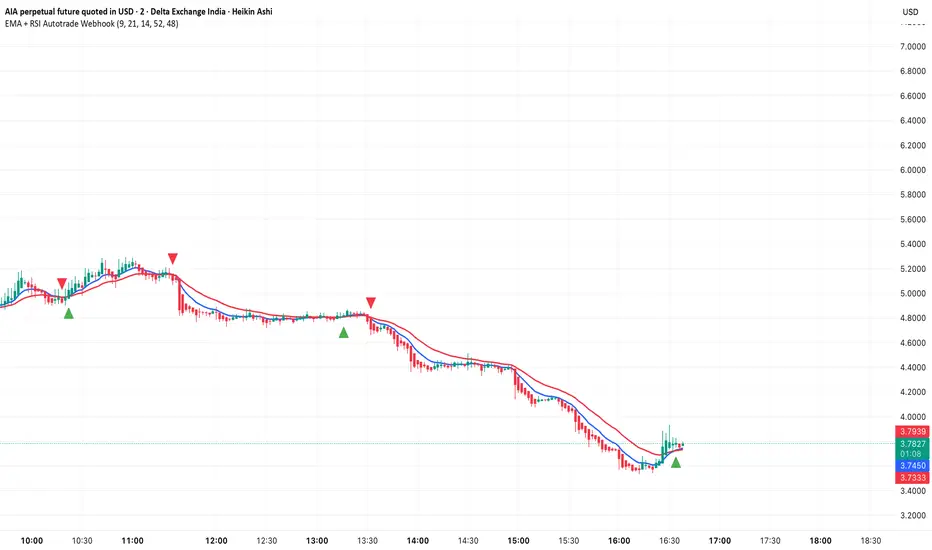
EMA + RSI Autotrade Webhook - VarunOverview
The EMA + RSI Autotrade Webhook is a powerful trend-following indicator designed for automated crypto futures trading. This indicator combines the reliability of Exponential Moving Average (EMA) crossovers with RSI momentum filtering to generate high-probability buy and sell signals optimized for webhook integration with crypto exchanges like Delta Exchange, Binance Futures, and Bybit.Key Features
Simple & Effective: Uses proven EMA 9/21 crossover strategy
RSI Momentum Filter: Eliminates low-probability trades in ranging markets
Webhook Ready: Two clean alerts (LONG Entry, SHORT Entry) for seamless automation
Exchange Compatible: Works with Delta Exchange, 3Commas, Alertatron, and other webhook platforms
Zero Lag Signals: Real-time alerts on crossover confirmation
Visual Clarity: Clean chart markers for easy signal identification
How It Works
Entry Signals:
LONG Entry: Triggers when EMA 9 crosses above EMA 21 AND RSI is above 52 (bullish momentum confirmed)
SHORT Entry: Triggers when EMA 9 crosses under EMA 21 AND RSI is below 48 (bearish momentum confirmed)
Technical Components:
Fast EMA: 9-period (tracks short-term price action)
Slow EMA: 21-period (identifies primary trend)
RSI: 14-period (confirms momentum strength)
RSI Long Threshold: 52 (filters weak bullish signals)
RSI Short Threshold: 48 (filters weak bearish signals)
Best Use Cases
Crypto Futures Trading: Bitcoin, Ethereum, Altcoin perpetual contracts
Automated Trading Bots: Integration with Delta Exchange webhooks, TradingView alerts
Timeframes: Optimized for 15-minute charts (works on 5min-1H)
Markets: Trending crypto markets with clear directional moves
Risk Management: Best used with 1-2% stop loss per trade (managed externally)
Webhook Automation Setup
Add indicator to your TradingView chart
Create alerts for "LONG Entry" and "SHORT Entry"
Configure webhook URL from your exchange (Delta Exchange, Binance, etc.)
Use alert message: Entry LONG {{ticker}} @ {{close}} or Entry SHORT {{ticker}} @ {{close}}
Exchange automatically reverses positions on opposite signals
Advantages
✅ No manual trading required - fully automated
✅ Eliminates emotional trading decisions
✅ Catches trending moves early with EMA crossovers
✅ RSI filter reduces whipsaws in choppy markets
✅ Works 24/7 without monitoring
✅ Simple two-alert system (easy to manage)
✅ Compatible with multiple exchanges via webhooksStrategy Philosophy
This indicator follows a trend-following with momentum confirmation approach. By waiting for both EMA crossover AND RSI confirmation, it ensures you're entering trades with genuine momentum behind them, not just random price noise. The tight RSI thresholds (52/48) keep you aligned with the prevailing trend.Recommended Settings
Timeframe: 15-minute (primary), 5-minute (scalping), 1-hour (swing)
Markets: BTC/USDT, ETH/USDT, high-liquidity altcoin perpetuals
Position Sizing: 100% capital per signal (exchange manages reversals)
Stop Loss: 2% (managed via exchange or external bot)
Leverage: 1-2x for conservative approach, up to 5x for aggressive
Important Notes
⚠️ This indicator generates entry signals only - position reversals are handled automatically by your exchange
⚠️ Always backtest on historical data before live trading
⚠️ Use proper risk management and position sizing
⚠️ Best performance in trending markets; may generate false signals in tight ranges
⚠️ Requires TradingView Premium or higher for webhook functionalityTags
cryptocurrency futures automated-trading ema-crossover rsi webhook delta-exchange tradingview-alerts trend-following momentum bitcoin ethereum crypto-bot algo-trading 15-minute-strategy
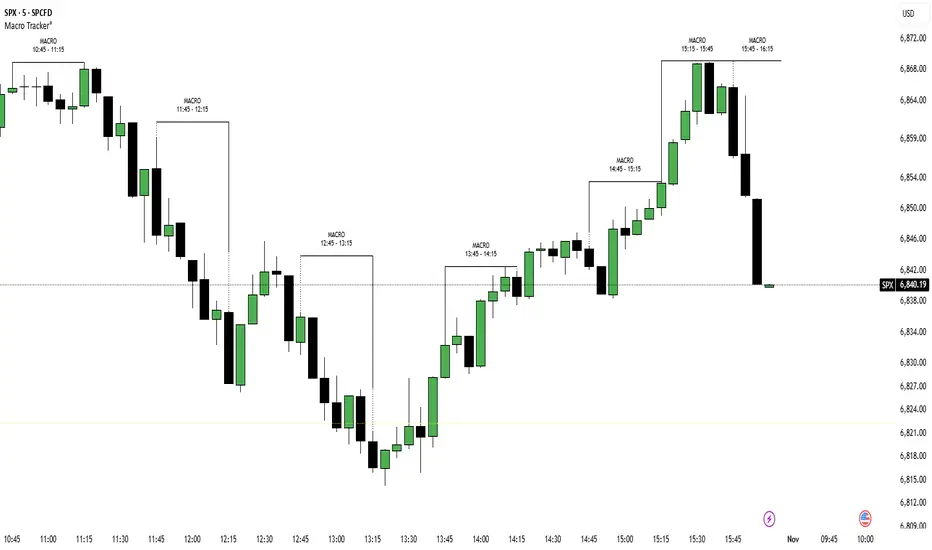
ICT Macro Tracker (xx:45-xx:15) (MTMGBS)Adjusted pinescript to reflect xx:45-xx:15 instead of the traditional xx:50-xx:15
Algoritmictrader2025 ALGO System profitability works with a minimum profit margin of 75% and the maximum profit margin per share is around 95%. The software costs $150 per month.

Ant_JJun 5-Minute Day-Trading IndicatorThis invite-only indicator is designed for short-term BTC and crypto trading, focusing on precision during volatile data-driven markets and capital protection during sideways conditions.
It integrates Ichimoku-based structure mapping with volume asymmetry analysis and proprietary rule-based filters.
Unlike a traditional mashup, this system does not simply overlay multiple indicators.
It uses Ichimoku’s leading spans to classify structural bias (trend vs. neutral), then evaluates directional confirmation through candle displacement and volume pressure imbalance.
Only when both structure and momentum align is a directional label printed.
If the system detects indecision (flat or overlapping clouds with contracting volume), it enters a neutral state to avoid unnecessary exposure.
Key concept:
— Preventing bleed during non-trending phases
— Adaptive response around macro/volatility events (e.g., CPI, PMI)
— Rule-based execution to remove emotional decision-making
Usage notes:
— Intended for 5-minute intraday use
— Long/Short labels appear only on rule-confirmed entries
— No repainting / no backfill logic
— Analytical use only — not investment advice

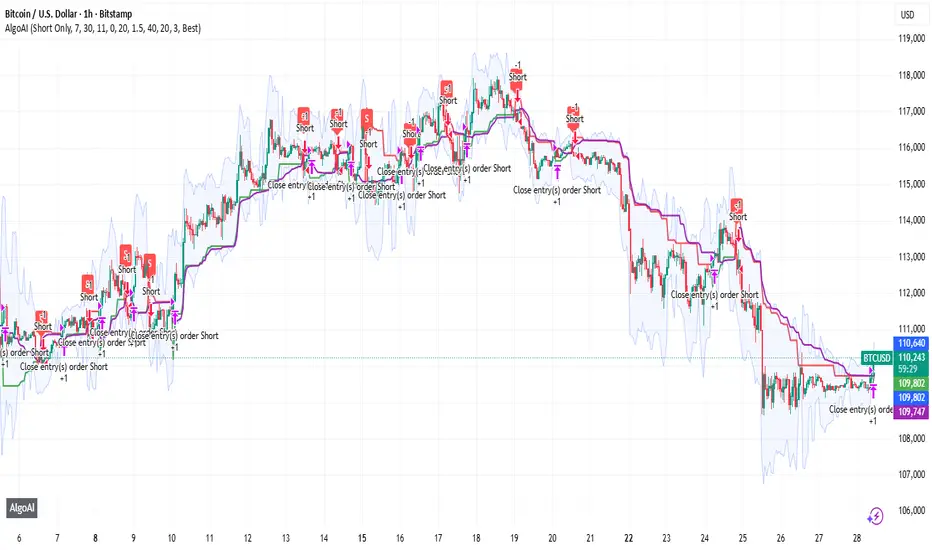
AlgoAIDESIGNED FOR HEIKEN ASHI BARS
Gain Access here: algoai.store
AlgoAI
The Dark Edge of Trading
An AI-powered TradingView strategy that thrives across all markets. Short altcoin pumps. Ride NAS100 waves. Dominate gold, FX, stocks, and futures — all with one AI brain.
#1
Semi-Automatic Trading (Recommended)
Set up alerts on AlgoAI signals. As they come in, grade the setups and choose to enter manually. This gives you full control while leveraging AI precision.
#2
Fully Automated Trading
Pass signals via webhooks to TradersPost for futures or PineConnector for FX. Note: When running fully automated, it's suggested to use long-only or short-only mode to avoid side swiping and potential unintended drawdown.
BITSTAMP:BTCUSD
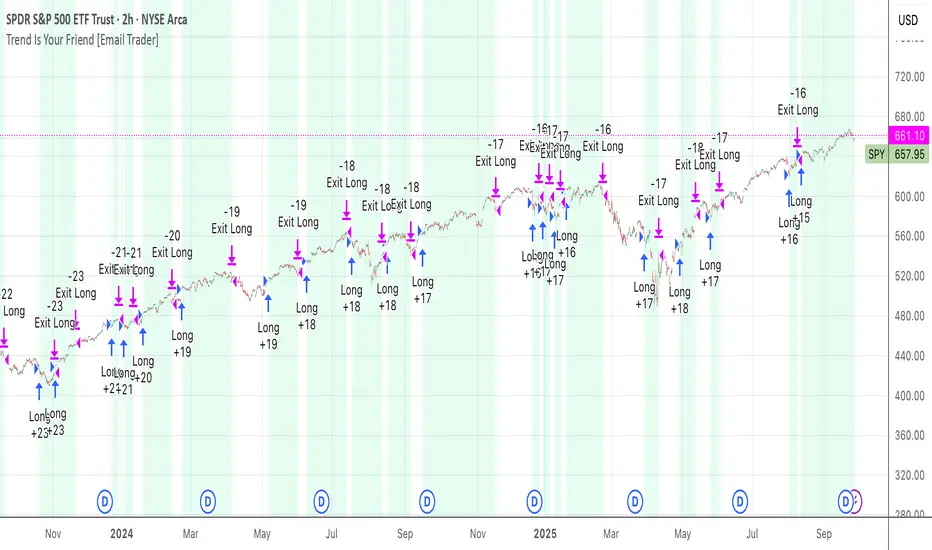
TrendIsYourFriend Strategy (SPY,IWM,VYM,XLK,SPXL,BTC,GOLD,VT...)Personal disclaimer
Don’t trust this strategy. Don’t trust any other model either just because of its author or a backtest curve. Overfitting is an easy trap, and beginners often fall into it. This script isn’t meant to impress you. It’s meant to survive reality. If it does, maybe it will raise questions and you’ll remember it.
Legal disclaimer
Educational purposes only. Not financial advice. Past performance is not indicative of future results.
Strategy description
Long-only, trend-based logic with two entry types (trend continuation or excess-move reversion), dynamic stop-losses, and a VIX filter to avoid turbulent markets.
Minimal number of parameters with enough trades to support robustness.
For backtest, each trade is sized at $10,000 flat (no compounding, to focus on raw model quality and the regularity of its results over time).
Fees = $0 (neutral choice, as brokers differ).
Slippage = $0, deliberate choice: most entries occur on higher timeframes, and some assets start their history on charts at very low prices, which would otherwise distort results.
What makes this script original
Beyond a classical trend calculation, both excess-move entries and dynamic stop-loss exits also rely on trend logic. Except for the VIX filter, everything comes from trend functions, with very few parameters.
Pre-configurations are fixed in the code, allowing sincere performance tracking across a dozen cases over the medium to long term.
Allowed
SPY (ARCA) — 2-hour chart: S&P 500 ETF, most liquid equity benchmark
IWM (ARCA) — Daily chart: Russell 2000 ETF, US small caps
VYM (ARCA) — Daily chart: Vanguard High Dividend Yield ETF
XLK (ARCA) — Daily chart: Technology Select Sector SPDR
SPXL (ARCA) — Daily chart: 3× leveraged S&P 500 ETF
BTCUSD (COINBASE) — 4-hour chart: Bitcoin vs USD
GOLD (TVC) — Daily chart: Gold spot price
VT (ARCA) — Daily chart: Vanguard Total World Stock ETF
PG (NYSE) — Daily chart: Procter & Gamble Co.
CQQQ (ARCA) — Daily chart: Invesco China Technology ETF
EWC (ARCA) — Daily chart: iShares MSCI Canada ETF
EWJ (ARCA) — Daily chart: iShares MSCI Japan ETF
How to use and form an opinion on it
Works only on the pairs above.
Feel free to modify the input parameters (slippage, fees, order size, margins, …) to see how the model behaves under your own conditions
Compare it with a simple Buy & Hold (requires an order size of 100% equity).
You may also want to look at its time-in-market — the share of time your capital is actually at risk.
Finally, let me INSIST on this : let it run live for months before forming an opinion!
Share your thoughts in the comments 🚀 if you’d like to discuss its live performance.
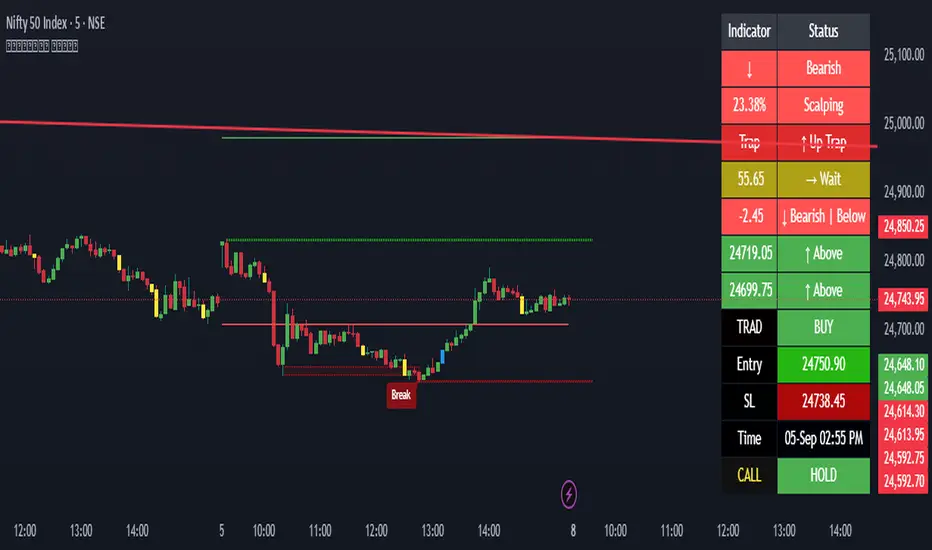
Apex Edge – Liquidity RaiderApex Edge – Liquidity Raider
The Predator That Hunts Where Retail Never Looks
The Liquidity Raider is not your average liquidity line plotter.
This is an institutional-grade hunting system that tracks the pools of liquidity Smart Money algos stalk — and tells you exactly when price is circling in for the strike.
Where most retail tools simply mark lines, this one acts like a predator:
Scans the chart dynamically to detect clustered highs & lows (pivot-based liquidity zones).
Filters noise with sensitivity & price rounding so you only get real liquidity levels — not every random swing.
Plots live BSL (Buy-Side Liquidity) & SSL (Sell-Side Liquidity) lines in clean dotted format.
Auto-deletes levels when swept, so your chart stays clean and focused.
Triggers directional arrows when price comes within your specified % distance to the target liquidity pool — before the market moves.
EMA confluence layer lets you align with institutional flow (customizable Fast & Slow EMAs).
Core Power
Cluster Logic – Finds high-probability liquidity zones using repeated pivot levels.
Sweep Awareness – Lines vanish the moment liquidity is taken, keeping focus on the next pool.
Proximity Strike Detection – Arrow signals only when price is within striking range.
Directional Clarity – Red arrows = targeting BSL, Green arrows = targeting SSL.
Scalable Across Timeframes – Adapts to your chart’s timeframe with dynamic lookback scaling.
Institutional Flow Filter – Optional EMA confirmation keeps you aligned with the real trend.
How to Use
Identify liquidity pools – Dotted green = buy-side, dotted red = sell-side.
Watch proximity arrows – These mean price is in range and hunting that pool.
Align with EMA bias – Enter only in the direction of institutional momentum.
Target the sweep – Your take profit is where the liquidity is resting.
Why Liquidity Raider Wins
This is not a lagging signal system.
It’s a real-time, clean, predictive tool designed to mimic the targeting logic of high-frequency algos.
By removing swept levels and focusing only on the next available pools, Liquidity Raider keeps you one step ahead of the crowd — and perfectly positioned for the kill shot.
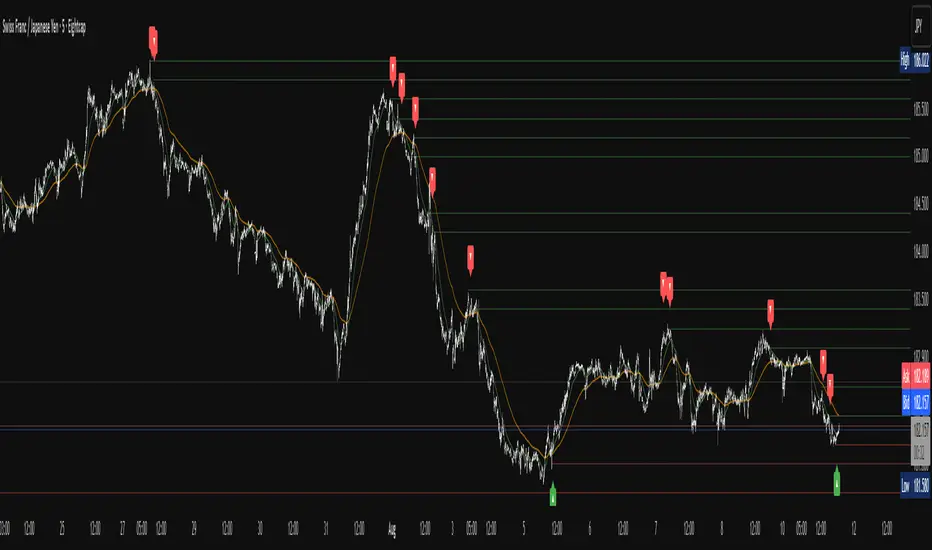
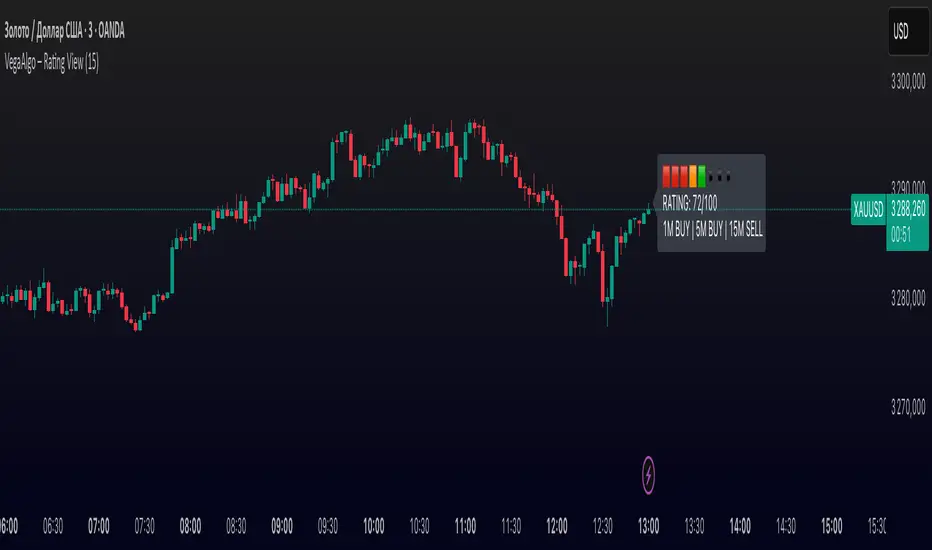
VegaAlgo – Rating ViewVegaAlgo – Rating View is a market condition analysis tool designed to evaluate the current price structure.
The indicator calculates a RATING (from 0 to 100) that reflects how clean, directional, and structured the recent price movement is. The rating is based on the number of price direction changes (from bullish to bearish candles and vice versa) within a selected period. Fewer direction changes indicate a clearer trend and result in a higher rating, while a choppy or highly volatile market leads to a lower score.
Additionally, the indicator provides directional signals on three key timeframes — 1M, 5M, and 15M, using a comparison of fast and slow moving averages. This allows traders to quickly assess the dominant trend both locally and across higher timeframes.
This script is intended for visual market analysis only and should not be considered financial advice.