The Order Flow ToolThe Order Flow Tool - Institutional-Grade Order Flow & Footprint Analysis
See the real buyers and sellers. No fake delta. No lag. No repaint. The Order Flow Tool exposes live executed order flow, volume footprint clusters, stacked imbalances, absorption zones, and liquidity traps so you can see who's actually controlling price. Built for futures, crypto, and CFDs.
Priceactionanalysis

Mkt-Viper ProMkt-Viper Pro
🔶 Overview
Mkt-Viper Pro is a comprehensive market intelligence suite designed to unify trend detection, structural analysis, and price action geometry into a single decision-making framework. Rather than relying on a single lagging calculation, Viper Pro utilizes a "Path Efficiency" model that weighs price movement against the energy (volatility and volume) required to achieve it.
The result is a chart overlay that separates statistically significant trend shifts from market noise. Traders receive adaptive Trend Signals based on volume and volatility thresholds, a background Trend Navigator Cloud for trend context, dynamic Kinetic Ranges for support/resistance, candle pattern detection, an automated Geometric Pattern engine, and much more detailed below. Internally, the system functions as a synaptic network—where momentum, volume, and price structure must align before a signal is validated.
In short, Mkt-Viper Pro is designed for traders who require a trend following and technical roadmap for filtering out low-quality volatility to focus on structural expansions and high-probability reversals.
🔶 What makes Mkt-Viper Pro unique?
Mkt-Viper Pro stands out by combining a volatility-adaptive trend engine with a complete confluence suite. Uniquely, it uses a "Path Efficiency" calculation to separate messy price action from true momentum, automatically filtering out noise during choppy markets. This core logic is then reinforced by multiple layers of environmental context—allowing you to check every move against the background Trend Navigator, Viper Band, Kinetic Ranges, geometric pattern engine and much more. Instead of relying on a single data point, the system provides you with suite of confluences to help you make well informed trading decisions.
Main Features
🔶 Viper Trend Signals
The core of the system is a sophisticated trend detection engine designed to filter out market noise. Instead of reacting to every minor price fluctuation, the algorithm evaluates momentum pressure relative to current volatility. It validates a directional shift only when the market exerts enough "energy" to breach calculated stability thresholds, ensuring that changes in trend are statistically significant rather than random noise.
These mechanics are translated onto the chart through a clean and intuitive visual interface:
Signal Logic:
Trend signals are generated when the price decisively shifts directional momentum. These are marked by clean Triangle Signals at the exact moment of the shift, keeping the chart uncluttered.
Trend Coloring:
To provide instant visual feedback on the market state, the indicator applies Candle Coloring in two distinct modes. Traders can choose a Static mode for clear, binary directional cues, or a Gradient mode that intensifies the color saturation as the trend gains strength and momentum.
Strong vs. Normal:
The system automatically grades every signal. A "Strong" classification is issued when the immediate momentum shift aligns perfectly with the broader, longer-term market context, identifying high-confluence setups with greater weight.
Auto-Tuning & Sensitivity Control
Market conditions are never static; volatility expands and contracts constantly. To address this, Viper Pro is equipped with a dual-mode calibration engine:
Auto-Tuning:
When enabled, the system actively measures "Path Efficiency"—calculating in real-time how choppy or direct price action is. It automatically adjusts its sensitivity, tightening validation criteria during clean trends and loosening them during chop to prevent false signals. Users can select from Fast, Moderate, or Slow profiles to suit their trading style.
Manual Tuning:
For traders who require fixed parameters for backtesting or specific asset classes, the system offers a granular 1–50 sensitivity dial. This allows for precise manual calibration to specific timeframes, giving you total control over how reactive the signals should be.
⚠️ Important:
These signals identify potential momentum shifts and should not be traded blindly. For high-probability outcomes, always validate the signal by ensuring it aligns with other confluences within the suite or other forms of technical analysis.
🔶 Trend Navigator Cloud
The Trend Navigator serves as the indicator’s "Context Awareness" layer, visualizing the broader ambient direction or "weather" of the market. Solving the classic dilemma between "lag" and "noise," this feature utilizes an Adaptive Flow Algorithm that adjusts its internal responsiveness based on real-time RSI and market velocity.
Smart Adaptation:
Instead of using a fixed lookback period that fails when market conditions change, the Navigator automatically detects the speed of price action. It tightens its tracking during impulsive trends to reduce lag, while loosening and smoothing itself during choppy consolidation to prevent false reversals.
Dynamic Structure:
The feature renders as a background cloud that expands and contracts with volatility. This creates a visual "breathing" support and resistance structure that naturally contains price action during healthy trends.
Usage:
Directional Bias:
When the Cloud is bullish color and below the trend, the macro environment is Bullish; look primarily for Long signals. When below the price action and bearish color, the environment is Bearish; focus on Short signals.
Trend Floor:
In established trends, the Cloud acts as a dynamic floor (or ceiling), highlighting high-probability zones for pullbacks and potential continuation entries.
Custom Tuning:
Users retain full control over the Navigator's behavior. You can enable Auto-Tuning to let the engine select the optimal sensitivity (Fast, Medium, or Slow) based on current conditions, or use the Manual Speed Dial (1–50) to fine-tune the cloud's reactivity to your specific timeframe or asset class.
🔶 Viper Band
The Viper Band is engineered as a multi-dimensional market utility, seamlessly consolidating four distinct technical concepts into a single, adaptive overlay. This unified approach provides a complete view of immediate price dynamics:
Trend Following:
It acts as an immediate directional filter. When the price is holding above the band, the short-term structure is Bullish; when below, it is Bearish. The band changes color dynamically to reinforce this state.
Dynamic Support & Resistance:
The outer edges of the band are volatility-adjusted. In a strong trend, the band creates a rising floor (or falling ceiling), acting as a trailing support zone where price often bounces to continue the move.
Market Equilibrium:
The center of the band represents the market's "fair value" or equilibrium point relative to the current timeframe. It filters out tick-by-tick noise to show the true mean price.
Price Magnet:
Because markets cannot stay overextended indefinitely, the Viper Band acts as a gravitational magnet. When price deviates too far from the band, it signals an overextended state, often preceding a "snap-back" or mean reversion event where price returns to the Band.
Usage:
Trend Health:
In a healthy, sustainable trend, the band often acts as a continuous trailing support or resistance zone.
Re-Entry:
For trend-followers, pullbacks that touch or test the Viper Band often present high-probability, low-risk opportunities to rejoin the dominant move.
🔶 Viper Kinetic Ranges (VKR)
Standard pivot points and static support lines often fail because they treat every trading session the same, ignoring the unique volatility profile of the current day. Viper Kinetic Ranges (VKR) solves this by generating dynamic Support and Resistance structures that actively adapt to the market's physical "energy."
Volume-Weighted Expansion:
Unlike standard volatility envelopes that rely solely on price range, VKR incorporates Volume Weighting. When volume flows into the market (e.g., during market opens or news events), the defined range automatically expands. This helps prevent "fake-out" signals by proving that the market needs more energy to validate a true breakout during high-activity periods.
State-Change Logic:
The levels do not drift aimlessly with every tick. Instead, they operate on a State-Change basis. The Support and Resistance levels remain locked and stable until the market exerts enough directional force to force a "state transition." When this happens, the levels "step" up or down to a new equilibrium zone. This stepping behavior helps traders visualize exactly when the market has accepted a new value area versus when it is simply ranging.
Concept:
Think of these levels as the "lungs" of the market. They expand and contract to show where price is statistically likely to find equilibrium or rejection based on the current expenditure of buying and selling energy.
Usage:
Trend Validation:
Use the central Equilibrium Level (Datum) as your directional "Line in the Sand." As long as price holds above this stepped line, the immediate value area is Bullish. A breach below signals a potential regime change.
Precision Targeting:
The outer Major Structures represent statistical exhaustion points extended by volatility. These are ideal, scientifically derived locations to set Take Profit orders or anticipate a mean-reversion bounce.
Support and Resistance:
Each level may produce some type of reaction and can act as support and resistance levels presenting potential opportunities for entries or profit taking.
🔶 Auto-Geometric Chart Patterns
Viper Pro features a "V7" pattern recognition engine that runs a continuous, frame-by-frame structural analysis of price action. Instead of waiting for a pattern to complete before drawing it (hindsight), this engine detects Wedges, Channels, and Triangles as they form in real-time.
Vertex Array Technology:
Unlike basic scripts that simply connect the highest highs and lowest lows, the Viper Engine stores historical pivot points in dynamic arrays. It analyzes the mathematical relationship between these points—calculating slope ratios and width consistency—to determine if a valid geometric structure exists.
⚠️ Technical Disclosure: Pattern Dynamic Regeneration
The Geometric Pattern Engine utilizes a process of "Functional Repainting" (Dynamic Object Regeneration). Because chart patterns such as Wedges and Channels are evolving structures, the indicator continuously re-evaluates the validity of vertices in real-time. As the price expands, trend lines will adjust to new market data to keep information relevant. Additionally, as price data unfolds, old patterns or invalidated patterns will be removed from the chart automatically in order to print a newer more recent pattern to keep your charts clean and up to date on the most recent price data.
🔶 Candle Pattern Recognition
The Candle Pattern Recognition Module utilizes a Context-Aware Engine to scan for high-probability Reversal and Continuation structures (Hammers, Stars, Dojis, and Absorptions).
Trend & Context Filtering:
A pattern is only as good as its location. The engine filters signals based on the broader trend (e.g., looking for Hammer candles only during downtrends and Falling Stars only during uptrends). This ensures you are trading reversals at logical structural points, not random noise.
Quality & Volume Logic:
The system includes an integrated "Quality Filter." It ignores patterns formed on low liquidity. For a signal to be valid, it must demonstrate a "Footprint of Interest"—verified by a relative spike in Volume or an expansion in ATR (Range) relative to the recent lookback period.
The Patterns:
Absorption:
Highlights powerful shifts in control (often called Engulfing) where one side decisively overtakes the other.
Stars & Hammers:
Pinpoints rejection wicks that signal exhaustion.
Dojis:
Identifies moments of indecision and potential equilibrium.
🔶 Swing Failure Pattern (SFP) Detection
Institutional trading often involves seeking liquidity at obvious structural levels. The SFP engine is designed to automatically detect these "Liquidity Sweeps" or "Bull/Bear Traps" where the market hunts for stop-losses before reversing.
The Logic:
The system actively monitors significant Pivot Points. An SFP is validated when the price pierces a key Pivot High or Low—taking out liquidity—but subsequently fails to hold that level and closes back within the previous range.
Visuals:
When a sweep occurs, the indicator plots a discrete dashed line connecting the original pivot to the current "sweep" candle. This visualizes the exact "Trap Zone" where breakout traders were caught offside, signaling a potential high-probability reversal opportunity.
Usage:
Fade the Breakout:
An SFP is a classic "Fade" signal. When a Bearish SFP appears at a high, it implies that buyers have potentially been trapped; traders often look for Short entries here. Conversely, a Bullish SFP at a low suggests sellers are trapped, offering a potential Long opportunity.
🔶 Reversal Cloud
The Reversal Cloud acts as a statistical boundary gauge, designed to visualize when price action has extended significantly beyond its average value. Markets typically spend the majority of their time within a standard distribution; this feature highlights the rare moments when volatility pushes price into statistical extremes.
The Logic:
The engine calculates a dynamic deviation envelope based on recent market volatility. Rather than predicting a specific turning point, it identifies zones where the market is "stretched" relative to its baseline. When price enters this colored "Horizon," it indicates that the current move is statistically extended, which historically correlates with periods of consolidation or mean reversion.
Visuals:
The feature renders as a shaded zone at the upper and lower limits of the chart. It remains passive during normal price action but highlights "Breach" events when price pushes into these outer deviation bands.
Usage:
Context Awareness:
Use the Cloud to gauge the maturity of a move. Entering new impulsive trades while inside the Reversal Cloud carries higher statistical risk, as the price is already far from equilibrium.
Reaction Watch:
For traders already in a position, a breach of the Cloud serves as a cue to tighten risk management or monitor for signs of momentum loss, as the market digests the recent expansion.
⚠️ Important Note:
While these zones represent statistical extremes, they are not hard barriers. In powerfully trending markets or during high-impact news events, price can "ride" or expand these bands for extended periods without reversing immediately. Do not trade these zones blindly; always wait for secondary confirmation of momentum loss (such as a structural break or a rejection candle) before anticipating a reversal.
🔶 Key Levels & Session Structure
Successful trading requires knowing where liquidity resides. Viper Pro automates the analysis of "Market Memory" by mapping significant historical and time-based structures directly onto your chart.
The Logic:
It automatically plots the Previous Day (PDH/PDL), Previous Week (PWH/PWL), and Previous Month (PMH/PML). These levels often act as major "Magnets" where price reverses or accelerates as it seeks liquidity.
Session Profiles:
Intraday price action is heavily influenced by the distinct behaviors of the global trading centers. This module highlights the trading ranges of the Asia, London, and New York sessions.
The Logic:
By visualizing the High and Low of the previous session, traders can spot "Session Sweeps"—a common phenomenon where the market manipulates price to break a prior session's high or low to trap traders before reversing.
Usage:
Confluence:
These levels serve as an excellent filter for Trend Signals. For example, a "Buy" signal generated directly below a Weekly High requires caution, whereas a signal bouncing off a Daily Low carries higher conviction.
Targeting:
Use these static structural levels as scientifically derived potential Take Profit zones, as price often pauses or reacts when testing these historical boundaries.
🔶 Opening Range Breakout (ORB)
The first 15 minutes of the trading session (09:30–09:45 ET) often establish the initial balance and sentiment for the entire trading day. The Viper ORB engine automates the identification of this critical volatility window.
The Logic:
The system defines the "Opening Range" by capturing the highest high and lowest low of the session's first 15 minutes. It waits for the opening time window to fully close before projecting the levels, ensuring you are planning trades against confirmed structure rather than developing noise.
Visuals:
Once the opening window concludes, two distinct levels (High and Low) are projected forward for the remainder of the session.
Usage:
Breakout Plays:
A clean close above the Opening Range High often signals strong buying intent, suggesting a trend day.
Range Fading:
If price breaks the range but fails to hold, price often rotates back to the opposite side of the opening range.
Support/Resistance Flip:
Later in the day, these levels often act as strong support or resistance when retested.
🔶 Visual Intelligence (Color Themes)
Visual clarity is essential for rapid decision-making. A cluttered or poorly contrasted chart can lead to cognitive fatigue. To address this, Mkt-Viper Pro features a global Color Theme Engine that instantly synchronizes every element of the suite—signals, candles, clouds, and text—to a unified palette.
The Presets:
The system comes with five professionally designed profiles to suit different trading environments and lighting conditions:
Viper Original: High-contrast Neon Green & Purple (Optimized for Dark Mode).
Classic: Standard Green/Red configuration for traditionalists.
Cool Blues: A calming Blue/Violet palette designed to reduce emotional reactivity.
Ember & Ash: High-warmth Orange/Slate contrast.
Monochrome: Grayscale/Silver logic for distraction-free structural analysis.
Customization:
Traders with specific branding requirements or accessibility needs (such as color blindness) can select "Custom Theme." This unlocks distinct color inputs, allowing you to define your own specific Bullish, Bearish, and Neutral colors that instantly propagate across the entire indicator suite.
🔶 How to use:
Mkt-Viper Pro is designed to reduce "Analysis Paralysis" by organizing data into a clear decision hierarchy. Rather than chasing every signal, we recommend a workflow based on Confluence:
Trend Continuation (The Pullback)
This is the highest probability approach, trading with the momentum.
1. Identify Trend:
Ensure the Viper Trend Signal is Bullish and the Navigator Cloud is bullish.
2. Wait for Value:
Do not chase pumps. Wait for price to pull back into the Navigator Cloud or the center of the Viper Band .
3. Trigger:
Look for a specific confirmation candle (e.g., a Hammer or Bullish Absorption ) to form within that support zone.
4. Target:
Target the next Kinetic Range (VKR) resistance level above.
Structural Reversal (The Fade)
1. Identify Exhaustion:
Wait for price to push into the Reversal Cloud (Statistical Extreme) or hit a major HTF Level (e.g., Previous Week High).
2. Spot the Trap:
Watch for an SFP (Swing Failure Pattern) or a Geometric Wedge pattern to form, indicating momentum loss.
3. Confirmation:
Wait for a counter-trend Candle Pattern (e.g., Falling Star) or a flip in the Viper Trend Signal before entering. Trying to catch a falling knife without this confirmation is not recommended.
The Breakout
Trading expansion from consolidation.
Context: Identify a tightening Geometric Pattern (Triangle) or a clearly defined
Opening Range (ORB) .
Expansion: Wait for a clean candle close outside of the pattern/range.
Validation: Ensure the breakout moves through the Kinetic Range Equilibrium , proving that real volume is backing the move.
Note:
Mkt-Viper Pro is engineered as a complete standalone system for Trend and Structural analysis. However, it also functions as the core "Chart Overlay" module within the wider Mkt-Viper 3-part ecosystem. It is calibrated to synchronize visually and mathematically with its sister scripts, ensuring a unified data view without conflicting signals.
🔶 Realistic Expectations & Risk Management
It is vital to understand that Mkt-Viper Pro is a technical analysis instrument, not a crystal ball. No algorithm can predict the future with 100% certainty. The goal of this system is not to eliminate losses, but to provide a statistical edge by aligning multiple factors of confluence.
Win Rate vs. Risk/Reward:
High-probability trading is not just about "Win Rate"; it is about the relationship between Risk and Reward.
The Edge:
By using the SFP wicks or Viper Band extremes for tight stop-loss placement, and targeting the Kinetic Ranges for exits, the system is designed to identify setups with favorable Risk-to-Reward ratios (e.g., 1:2 or 1:3).
The Reality:
Even a system with a modest win rate can be highly profitable if the winning trades are larger than the losing trades. This suite is built to help you identify those skewed opportunities.
Market Conditions & Drawdown:
Like all trend-following systems, the greatest risk occurs during undefined, choppy range-bound markets where price whipsaws without momentum.
While the "Path Efficiency" filter is designed to minimize this, false signals can and will occur during periods of low liquidity.
Mitigation:
We strongly recommend avoiding entries when the Navigator Cloud is flat/contracted (indicating zero momentum) or when price is stuck between two tight Kinetic Range levels.
---------------------
Disclaimer
The content provided in my scripts, indicators, ideas, algorithms, and systems is for educational and informational purposes only. It does not constitute financial advice, investment recommendations, or a solicitation to buy or sell any financial instruments. I will not accept liability for any loss or damage, including without limitation any loss of profit, which may arise directly or indirectly from the use of or reliance on such information.
All investments involve risk, and the past performance of a security, industry, sector, market, financial product, trading strategy, back test, or individual's trading does not guarantee future results or returns. Investors are fully responsible for any investment decisions they make. Such decisions should be based solely on an evaluation of their financial circumstances, investment objectives, risk tolerance, and liquidity needs.

eBacktesting - Learning: Trend LineseBacktesting - Learning: Trend Lines helps you spot clean trend lines automatically, using real swing points (highs/lows) and confirming a line only after it’s “respected” multiple times.
What you’ll see on the chart
- Uptrend lines (support) when price is making higher lows
- Downtrend lines (resistance) when price is making lower highs
- A simple way to study structure, spot “respect” of a trend line, and understand when a trend may be weakening
- Trend line breaks are based on candle closes, not just quick wicks, so the signals are clearer
You can also keep a few older lines on the chart, making it easy to review past reactions and build pattern recognition.
These indicators are built to pair perfectly with the eBacktesting extension, where traders can practice these concepts step-by-step. Backtesting concepts visually like this is one of the fastest ways to learn, build confidence, and improve trading performance.
Educational use only. Not financial advice.

Market Structure HighLow + Liquidity [MaB]📊 Market Structure HighLow + Liquidity
A comprehensive indicator combining precision market structure analysis with real-time liquidity zone detection.
━━━━━━━━━━━━━━━━━━━━━━━━━━━━━━━━━━━━━━━━
🔬 HOW THE ALGORITHM WORKS
1. Swing Point Detection Logic
Unlike simple pivot-based indicators, this script uses a custom state machine that tracks price action in real-time:
Candidate Detection: When price makes a new high, the algorithm waits for a candle to CLOSE below the low of that high candle. This "close below trigger" initiates a candidate state.
Dual Confirmation System: A candidate becomes a validated swing point only when BOTH conditions are met:
Time Filter: A minimum number of candles must pass (configurable, default: 5)
Price Filter: Price must retrace by a minimum percentage of the previous leg's range (configurable, default: 10%)
Dynamic Threshold Adjustment: When the current leg amplitude exceeds 2.5× the average of the last 20 legs, the algorithm automatically relaxes confirmation filters to avoid missing extended moves.
2. Trend State Machine
The indicator maintains an internal trend state (Uptrend/Downtrend) that determines how price action is interpreted:
Uptrend Mode: Searches for Higher Highs and Higher Lows. A confirmed High triggers monitoring for breakout above that level.
Downtrend Mode: Searches for Lower Highs and Lower Lows. A confirmed Low triggers monitoring for breakdown below that level.
Trend Inversion: When price closes beyond the opposite structure point by the Breakout Threshold %, the trend state flips and the search pattern reverses.
3. FVG (Fair Value Gap) Detection
The algorithm scans for 3-candle patterns where a gap exists between candle 1's high/low and candle 3's low/high:
Bullish FVG: low > high AND close > high — gap above, indicating buying pressure
Bearish FVG: high < low AND close < low — gap below, indicating selling pressure
4. Imbalance vs Inducement Classification
This is the key innovation of this indicator:
Inducement Zone: An FVG detected BEFORE the next structural breakout is confirmed. These often act as liquidity traps where stops are hunted before the real move.
Imbalance Zone: An FVG that survives until breakout confirmation. When price breaks structure, the last active Inducement converts to an Imbalance, signaling a validated supply/demand zone.
Detection Flow:
High Confirmed → Start scanning for FVGs → Each FVG = Inducement
↓
Breakout Confirmed → Last Inducement → Imbalance
5. Zone Touch Detection
Zones are monitored each bar. A zone is considered "touched" when:
Supply Zone: high >= zone_bottom + (zone_height × retracement%)
Demand Zone: low <= zone_top - (zone_height × retracement%)
At 0% retracement, first contact closes the zone. At 100%, price must fully traverse it.
6. Zone Size Filter
To avoid noise from insignificant zones, the algorithm maintains a rolling average of the last 50 zone heights:
Zones smaller than (100% - tolerance%) of the average are rejected
With default 85% tolerance: zones below 15% of average size are filtered out
Large zones are always accepted regardless of size
━━━━━━━━━━━━━━━━━━━━━━━━━━━━━━━━━━━━━━━━
⚙️ PARAMETERS EXPLAINED
Market Structure
Min Confirmation Candles (default: 5) — Bars required after candidate detection
Pullback Percentage (default: 10%) — Minimum retracement of leg range
Breakout Threshold (default: 1%) — Distance beyond structure for confirmed break
Liquidity
Zone Size Tolerance (default: 85%) — Filters zones smaller than 15% of average size
Min Zones for Average (default: 10) — Zones needed before size filter activates
Zone Retracement (default: 0%) — How deep price must enter to invalidate zone
━━━━━━━━━━━━━━━━━━━━━━━━━━━━━━━━━━━━━━━━
🎨 VISUAL GUIDE
Structure Lines:
🟢 Green = Uptrend leg (L→H in uptrend)
🔴 Red = Downtrend leg (H→L in downtrend)
⚪ Gray = Trend inversion point
Zone Colors:
🔴 Red = Imbalance Supply (validated resistance)
🟢 Green = Imbalance Demand (validated support)
🟠 Orange = Inducement Supply (potential bull trap)
🔵 Blue = Inducement Demand (potential bear trap)
━━━━━━━━━━━━━━━━━━━━━━━━━━━━━━━━━━━━━━━━
💡 PRACTICAL USAGE
Trend Following: Trade in direction of colored lines (green = long bias, red = short bias)
Zone Entries: Look for price returning to Imbalance zones for high-probability entries
Trap Avoidance: Inducement zones warn of potential stop-hunts before real moves
Breakout Confirmation: Wait for "Br↑" or "Br↓" labels before entering breakout trades
━━━━━━━━━━━━━━━━━━━━━━━━━━━━━━━━━━━━━━━━
⚠️ NOTES
Best on 1H+ timeframes for cleaner structure
Inducements often convert to Imbalances after breakout
Use Replay Mode when backtesting to prevent buffer errors
Faded zones show historical levels that have been touched

MidZone Breakout Pro 🚀 MidZone Breakout Pro — Smart Balance Zone Signals
🧭 Equilibrium-Based Market Insight
MidZone Breakout Pro identifies key balance levels in the market and highlights directional opportunities when price decisively moves away from equilibrium.
📐 Dynamic Midpoint Zone Mapping
Automatically plots a central price balance zone derived from recent market ranges, helping traders visualize fair value and expansion areas.
🎯 Clear Buy & Sell Signals
Generates clean bullish and bearish signals when price exits the balance zone with momentum.
🎨 High-Visibility Zone Visualization
Color-coded zones, background shading, and bold signal markers provide instant clarity without chart clutter.
🎚 Customizable Sensitivity
Adjustable lookback period and zone width allow seamless adaptation across scalping, intraday, and swing trading.
🕰 Non-Repainting Signals
All signals are calculated using confirmed price action and remain stable on historical charts.
⚡ Lightweight & Fast Performance
Optimized design ensures smooth performance across all instruments and timeframes.
🛠 How to Use (Safe Version)
📉 **Buy Signal**: Appears when price moves strongly above the balance zone
📈 **Sell Signal**: Appears when price moves strongly below the balance zone
🟨 **Neutral Zone**: Indicates consolidation or equilibrium conditions
Best used in combination with trend direction, support/resistance, or volume confirmation.
⚠️ Disclaimer: This indicator is for educational and analytical purposes only. It does not provide financial advice. Always apply proper risk management.

Apex ICT: Proximity & Delivery FlowThis indicator is a specialized ICT execution tool that automates the identification of Order Blocks, Fair Value Gaps, and Changes in State of Delivery (CISD). Unlike standard indicators that clutter the screen, this script uses a Proximity Logic Engine to ensure you only see tradeable levels. It automatically purges old data (50-candle CISD limit) and deletes mitigated zones the moment they are breached, leaving you with a clean, institutional-grade chart.

Photon Price Action Scanner [JOAT]Photon Price Action Scanner - Multi-Pattern Recognition with Adaptive Filtering
Introduction and Purpose
Photon Price Action Scanner is an open-source overlay indicator that automates the detection of 15+ candlestick patterns while filtering them through multiple confirmation layers. The core problem this indicator solves is pattern noise: raw candlestick pattern detection produces too many signals, most of which fail because they lack context. This indicator addresses that by combining pattern recognition with trend alignment, volume-weighted strength scoring, velocity confirmation, and an adaptive neural bias filter.
The combination of these components is not arbitrary. Each filter addresses a specific weakness in standalone pattern detection:
Trend alignment ensures patterns appear in favorable market structure
Volume-weighted strength filters out weak patterns with low conviction
Velocity confirmation identifies momentum behind the pattern
Neural bias filter adapts to recent price behavior to avoid counter-trend signals
What Makes This Indicator Original
While candlestick pattern scanners exist, this indicator's originality comes from:
1. Multi-Layer Filtering System - Patterns must pass through trend, strength, velocity, and neural bias filters before generating signals. This dramatically reduces false positives compared to simple pattern detection.
2. Adaptive Neural Bias Filter - A custom momentum-adjusted EMA that learns from recent price action using a configurable learning rate. This is not a standard moving average but an adaptive filter that accelerates during trends and smooths during consolidation.
3. Pattern Strength Scoring - Each pattern receives a strength score based on volume ratio and body size, allowing traders to focus on high-conviction setups rather than every pattern occurrence.
4. Smart Cooldown System - Prevents signal overlap by enforcing minimum bar spacing between pattern labels, keeping charts clean even when "Show All Patterns" is enabled.
How the Components Work Together
Step 1: Pattern Detection
The indicator scans for 15 candlestick patterns using precise mathematical definitions:
// Example: Bullish Engulfing requires the current bullish candle to completely
// engulf the previous bearish candle with a larger body
isBullishEngulfing() =>
bool pattern = close < open and close > open and
open <= close and close >= open and
close - open > open - close
pattern
// Example: Three White Soldiers requires three consecutive bullish candles
// with each opening within the previous body and closing higher
isThreeWhiteSoldiers() =>
bool pattern = close > open and close > open and close > open and
close < close and close < close and
open > open and open < close and
open > open and open < close
pattern
Step 2: Strength Calculation
Each detected pattern receives a strength score combining volume and body size:
float volRatio = avgVolume > 0 ? volume / avgVolume : 1.0
float bodySize = math.abs(close - open) / close
float baseStrength = (volRatio + bodySize * 100) / 2
This ensures patterns with above-average volume and large bodies score higher than weak patterns on low volume.
Step 3: Trend Alignment
Patterns are checked against the trend direction using an EMA:
float trendEMA = ta.ema(close, i_trendPeriod)
int trendDir = close > trendEMA ? 1 : close < trendEMA ? -1 : 0
Bullish patterns in uptrends and bearish patterns in downtrends receive priority.
Step 4: Neural Bias Filter
The adaptive filter uses a momentum-adjusted EMA that responds to price changes:
neuralEMA(series float src, simple int period, simple float lr) =>
var float neuralValue = na
var float momentum = 0.0
if na(neuralValue)
neuralValue := src
float error = src - neuralValue
float adjustment = error * lr
momentum := momentum * 0.9 + adjustment * 0.1
neuralValue := neuralValue + adjustment + momentum
neuralValue
The learning rate (lr) controls how quickly the filter adapts. Higher values make it more responsive; lower values make it smoother.
Step 5: Velocity Confirmation
Price velocity (rate of change) must exceed the average velocity for strong signals:
float velocity = ta.roc(close, i_trendPeriod)
float avgVelocity = ta.sma(velocity, i_trendPeriod)
bool velocityBull = velocity > avgVelocity * 1.5
Step 6: Signal Classification
Signals are classified based on how many filters they pass:
Strong Pattern : Pattern + strength threshold + trend alignment + neural bias + velocity
Ultra Pattern : Strong pattern + gap in same direction + velocity confirmation
Watch Pattern : Pattern detected but not all filters passed
Detected Patterns
Classic Reversal Patterns:
Bullish/Bearish Engulfing - Complete body engulfment with larger body
Hammer - Long lower wick (2x body), small upper wick, bullish context
Shooting Star - Long upper wick (2x body), small lower wick, bearish context
Morning Star - Three-bar bullish reversal with small middle body
Evening Star - Three-bar bearish reversal with small middle body
Piercing Line - Bullish candle closing above midpoint of previous bearish candle
Dark Cloud Cover - Bearish candle closing below midpoint of previous bullish candle
Bullish/Bearish Harami - Small body contained within previous larger body
Doji - Body less than 10% of total range (indecision)
Advanced Patterns (Optional):
Three White Soldiers - Three consecutive bullish candles with rising closes
Three Black Crows - Three consecutive bearish candles with falling closes
Tweezer Top - Equal highs with reversal candle structure
Tweezer Bottom - Equal lows with reversal candle structure
Island Reversal - Gap isolation creating reversal structure
Dashboard Information
The dashboard displays real-time analysis:
Pattern - Current detected pattern name or "SCANNING..."
Bull/Bear Strength - Volume-weighted strength scores
Trend - UPTREND, DOWNTREND, or SIDEWAYS based on EMA
RSI - 14-period RSI for momentum context
Momentum - 10-period momentum reading
Volatility - ATR as percentage of price
Neural Bias - BULLISH, BEARISH, or NEUTRAL from adaptive filter
Action - ULTRA BUY/SELL, BUY/SELL, WATCH BUY/SELL, or WAIT
Visual Elements
Pattern Labels - Abbreviated codes (BE=Engulfing, H=Hammer, MS=Morning Star, etc.)
Neural Bias Line - Adaptive trend line showing filter direction
Gap Boxes - Cyan boxes highlighting price gaps
Action Zones - Dashed boxes around strong pattern areas
Velocity Markers - Small circles when velocity confirms direction
Ultra Signals - Large labels for highest conviction setups
How to Use This Indicator
For Reversal Trading:
1. Wait for a pattern to appear at a key support/resistance level
2. Check that the Action shows "BUY" or "SELL" (not just "WATCH")
3. Confirm the Neural Bias aligns with your trade direction
4. Use the strength score to gauge conviction (higher is better)
For Trend Continuation:
1. Identify the trend using the Trend row in the dashboard
2. Look for patterns that align with the trend (bullish patterns in uptrends)
3. Ultra signals indicate the strongest continuation setups
For Filtering Noise:
1. Keep "Show All Patterns" disabled to see only filtered signals
2. Increase "Pattern Strength Filter" to see fewer, higher-quality patterns
3. Enable "Velocity Confirmation" to require momentum behind patterns
Input Parameters
Scan Sensitivity (1.0) - Overall detection sensitivity multiplier
Pattern Strength Filter (3) - Minimum strength score for strong signals
Trend Period (20) - EMA period for trend determination
Show All Patterns (false) - Display all patterns regardless of filters
Advanced Patterns (true) - Enable soldiers/crows/tweezer detection
Gap Analysis (true) - Enable gap detection and boxes
Velocity Confirmation (true) - Require velocity for strong signals
Neural Bias Filter (true) - Enable adaptive trend filter
Neural Period (50) - Lookback for neural bias calculation
Neural Learning Rate (0.12) - Adaptation speed (0.01-0.5)
Timeframe Recommendations
1H-4H: Best balance of signal frequency and reliability
Daily: Fewer but more significant patterns
15m-30m: More signals, requires tighter filtering (increase strength threshold)
Limitations
Pattern detection is mechanical and does not consider fundamental context
Neural bias filter may lag during rapid trend reversals
Gap detection requires clean price data without after-hours gaps
Strength scoring favors high-volume patterns, which may miss valid low-volume setups
- Made with passion by officialjackofalltrades

BOS Zones (Order Blocks) [VCAI]BOS Zones (Order Blocks)
BOS Zones (Order Blocks) is a market-structure visualiser that highlights Breaks of Structure (BOS) and automatically marks the price zones formed immediately before the break.
Instead of guessing where structure changed or manually drawing zones, this indicator does the work for you and keeps the chart clean.
What This Indicator Does
• Detects bullish and bearish Breaks of Structure
• Identifies the last opposing candle before the break
• Draws a clear zone (order-block style) from that candle
• Projects the zone forward for future interaction
• Optionally shows midlines for refined price reference
How to Read It
• Bullish BOS
When price breaks above a prior swing high, the indicator marks the last bearish candle before the break and draws a bullish zone.
• Bearish BOS
When price breaks below a prior swing low, the indicator marks the last bullish candle before the break and draws a bearish zone.
These zones often act as areas of interest where price may react, stall, or reverse.
Why This Is Useful
Most traders:
miss structure shifts
draw zones inconsistently
clutter charts with too many lines
BOS Zones gives you:
• Objective structure breaks
• Consistent zone placement
• Clean, readable visuals
• Fewer decisions, less noise
Customisation Options
• Control swing sensitivity
• Limit how many zones are displayed
• Toggle boxes, midlines, and markers
• Automatically clean old zones
Inputs are intentionally limited to avoid over-optimisation.
What This Indicator Is NOT
• No buy or sell signals
• No trade automation
• No prediction or future-looking logic
This is a structure and context tool, designed to support discretionary analysis.
Best Use Cases
• Market structure analysis
• Supply & demand / order block trading
• Confluence with trend tools
• Higher-timeframe bias mapping
Works across Crypto, Forex, Indices, and Commodities.
Final Note
This indicator does not repaint structure breaks once confirmed.
All zones are derived from historical price action only.

Candle 2 Closure [LuxAlgo]The Candle 2 Closure tool detects a specific reversal pattern on the chart spanning four bars. The first bar trades into a key price level. The second bar trades outside the first bar's range, but closes inside, indicating a reversal. The third bar closes outside the second bar's range, in the direction of the reversal, creating a price expansion. The fourth bar is a continuation of prices in that same direction.
This tool features key levels, equilibrium zones, and real-time alarms upon confirmation of the second and third candles of the pattern.
This specific part of the more complete Fractal model by TTrades was requested by a lot of you. We are happy to bring it to you and wish you a merry Christmas!
🔶 USAGE
This pattern is a TTrades concept: a reversal setup that is very easy to understand. It occurs when the current bar trades outside of the previous bar's range, but closes inside it. In other words, traders try to push prices outside of the previous bar's range, but fail. This is considered a reversal, meaning that traders encountered opposing forces that overwhelmed them. Thus, the expectation is that prices will trade in the new direction, changing the market bias from bullish to bearish, or vice versa.
Let's look at the example in the chart, where the four candles of this setup are marked. Note that we have selected a perfect setup, where all conditions are met.
Candle 1: This bar traded into a key price area at the top of the range, spanning several months.
Candle 2: This bar traded outside the range of Candle 1, but failed to close outside. This is the reversal.
Candle 3: The wick of this bar formed at or below the equilibrium zone of Candle 2, and it closed outside the range of Candle 2. This is the expansion.
Candle 4: At this point, the setup is complete, and the expectation for this candle is that it will trade in the same direction. The top of the candle is at or below the equilibrium zone of Candle 3. This is the continuation.
In a strong setup, the top or bottom of the next bar will form inside the equilibrium zone defined by the highlighted areas on candles 2 and 3.
This is a perfect bearish setup, featuring all elements. Not all setups will be like this, but when this setup occurs, it is important for traders to be aware of it.
The tool is highly customizable from the settings panel and features real-time alerts at candle 2 and 3 confirmations.
Now, let's take a broader view of the same chart. We have disabled the display of candle 2 and filtered the setups with a length of 50.
As we can see, most of the last 17 setups found on the EUR/USD daily chart lead to multi-day or multi-month price movements.
🔹 Filtering Reversals
The tool features a reversals filter that is disabled by default. This filter allows us to filter out minor reversals and display only those that are important.
Traders can adjust the length parameter to display reversals only at the top or bottom of the last N specified bars. We can see some examples in the chart.
🔹 Wick Threshold
From the settings panel, traders can fine-tune the equilibrium zone for candle 2.
If the wick exceeds the threshold expressed as a percentage of the total bar range, the equilibrium zone will be calculated based only on the wick. In all other cases, the full bar range will be used.
🔶 SETTINGS
Candle 2 (Reversal): Enable or disable Candle 2 reversals.
Candle 3 (Expansion): Enable or disable Candle 3 expansions.
Reversals Filter: Filter reversals as the highest or lowest of the last N bars.
Wick Threshold %: Filter wicks as percentage of total bar range.
🔹 Style
Bullish Color: Select bullish color.
Bearish Color: Select bearish color.
Transparency: Select the transparency level. 0 is solid and 100 is fully transparent.
Levels: Enable or disable the horizontal levels.
Candle 2 Zone: Enable or disable the Candle 2 equilibrium zones.
Candle 3 Zone: Enable or disable the Candle 3 equilibrium zones.
🔹 Alerts
Candle 2 Alerts: Enable or disable Candle 2 alerts.
Candle 3 Alerts: Enable or disable Candle 3 alerts.

SMA MAD Trend [Alpha Extract]A sophisticated trend identification system that combines Simple Moving Average with Mean Absolute Deviation methodology to create adaptive Super Trend-style bands with advanced strength filtering and gradient visualization. Utilizing ADX-based trend strength validation and slope analysis for signal quality enhancement, this indicator delivers institutional-grade trend detection with dynamic ATR-based ribbon visualization and comprehensive strength measurement. The system's dual-filter architecture eliminates false signals during weak or choppy market conditions while maintaining sensitivity to genuine trend establishment and reversal events.
🔶 Advanced SMA-MAD Band Construction
Implements innovative Mean Absolute Deviation calculation around Simple Moving Average baseline to create volatility-adaptive bands with ratcheting logic for trend persistence. The system calculates MAD by measuring absolute price deviations from the mean, then applies configurable multipliers to generate upper and lower bands that adjust to changing market conditions while preventing premature band violations.
// Core SMA-MAD Framework
SMA_Value = ta.sma(close, SMA_Length)
Mean = ta.sma(close, MAD_Length)
Abs_Deviation = abs(close - Mean)
MAD_Value = ta.sma(Abs_Deviation, MAD_Length)
// Adaptive Bands
Upper_Band = SMA_Value + MAD_Factor * MAD_Value
Lower_Band = SMA_Value - MAD_Factor * MAD_Value
🔶 Intelligent Dual-Filter System
Features comprehensive trend validation using ADX strength measurement and slope analysis to eliminate low-conviction signals during ranging or consolidating markets. The system calculates normalized slope strength using ATR scaling and combines with ADX threshold analysis, generating filtered trend states that distinguish genuine trends from temporary price fluctuations.
🔶 Dynamic Trend Strength Engine
Implements sophisticated strength calculation combining slope intensity and ADX readings to produce normalized 0-100% strength scores with gradient colour intensity modulation. The system normalizes slope by minimum threshold and ADX by configurable level, multiplying factors to create composite strength measurement that drives visual feedback intensity across all indicator elements.
🔶 Super Trend-Style Direction Logic
Utilizes classic Super Trend methodology adapted for SMA-MAD bands, where trend direction flips occur on opposite band violations with persistent state maintenance. The system tracks previous band levels with ratcheting behaviour that adjusts bands only when price movement or new calculations warrant changes, preventing oscillation during normal volatility.
🔶 ATR-Based Ribbon Visualization
Provides dynamic ribbon overlay using ATR-scaled width around the trend line with opacity modulation based on trend strength for intuitive conviction assessment. The system creates upper and lower ribbon bounds at configurable ATR multiples, filling the channel with gradient-adjusted transparency that increases during strong trends and fades during weak conditions.
🔶 Multi-Dimensional Visual Architecture
Provides complete chart integration through trend line overlay, ATR ribbon fills, candle colouring, background glow, and transition signal labels with configurable visibility toggles. The system enables traders to customize display density from minimal (trend line only) to comprehensive (all visual elements) while maintaining consistent colour scheme and strength-based intensity across components.
🔶 Slope Strength Validation
Calculates ATR-normalized slope over configurable lookback periods to measure trend line momentum and filter sideways price action. The system compares absolute slope against minimum threshold requirements, preventing trend signals when price movement relative to the trend line lacks sufficient directional conviction regardless of band position.
🔶 Signal Generation Framework
Generates trend change signals when filtered direction state transitions from bearish to bullish or vice versa, with label placement and alert integration. The system implements state persistence that maintains previous trend until both ADX and slope filters confirm directional change, reducing whipsaw signals while capturing genuine reversals with minimal lag.
🔶 Performance Optimization Framework
Utilizes efficient calculation methods with optimized variable management and configurable parameters for balance between responsiveness and stability. The system includes intelligent state tracking with NA handling for initial bars and smooth gradient calculations that maintain performance across extended historical periods and real-time updates.
This indicator delivers sophisticated trend identification through Mean Absolute Deviation methodology combined with dual-strength filtering for superior signal quality. Unlike traditional Super Trend indicators that rely solely on ATR bands, the SMA-MAD approach uses statistical deviation measurement while incorporating ADX strength and slope validation to eliminate false signals during choppy conditions. The system's gradient-based visual feedback, ATR ribbon visualization, comprehensive dashboard, and multi-dimensional filtering make it essential for traders seeking reliable trend-following approaches with clear conviction measurement across cryptocurrency, forex, and equity markets. The combination of adaptive bands, strength-based transparency, and intelligent filtering creates an institutional-grade trend system suitable for systematic trading strategies.

Liquidity Sweep Sniper AP StyleAP Capital – Liquidity Sweep Sniper (Fab-Style)
📌 Overview
This indicator is a precision scalping tool inspired by professional liquidity-based trading concepts often demonstrated by elite intraday scalpers.
The script focuses on liquidity sweeps followed by strong displacement, aiming to capture short, high-probability momentum moves — particularly effective on lower timeframes (1–5 min) during active market sessions.
It is not a signal spam tool. Signals appear only when multiple objective conditions align.
🧠 Core Concept
Markets do not move randomly — they seek liquidity before expanding.
This indicator identifies:
Buy-side / Sell-side liquidity
Liquidity sweeps (stop-hunts)
Strong displacement candles reclaiming price
Optional higher-timeframe trend alignment
Only when all conditions are met does a signal print.
🔍 What the Indicator Detects
1️⃣ Liquidity Pools
Equal highs or equal lows detected within a configurable lookback
Minimum number of touches required
ATR-based tolerance to adapt to volatility
These levels represent areas where stop orders are likely resting.
2️⃣ Liquidity Sweep
A valid sweep requires:
Price to wick beyond the liquidity level
Candle to close back inside the range
This indicates failed breakout / stop-hunt behaviour.
3️⃣ Displacement Confirmation
After the sweep, the candle must show:
Strong body (default >60% of candle range)
Candle range large relative to ATR
Clear directional intent (momentum)
This filters out weak reactions and chop.
4️⃣ Optional Trend Filter
EMA-based higher-timeframe bias
Helps align scalps with dominant direction
Can be enabled or disabled
📈 Signals
BUY: Sell-side liquidity sweep → bullish displacement
SELL: Buy-side liquidity sweep → bearish displacement
Signals are plotted directly on the chart and can be used with alerts.
⚙️ Recommended Usage
Markets: XAUUSD, indices, liquid FX pairs
Timeframes: 1m–5m
Sessions: London & New York (best performance)
Risk Management: Always required — this tool does not place trades
Best used as a confirmation tool, not standalone.
⚠️ Important Notes
This indicator is inspired by liquidity-based scalping concepts, not an exact replication of any individual trader’s private strategy.
No indicator predicts the future — this tool highlights high-probability scenarios, not guarantees.
Past performance is not indicative of future results.

TCR by AMAGADON TCR - THREE CANDLE RULES
The Methodology
TCR (Three Candle Rules) is a systematic confirmation indicator developed to solve the problem of "False Breakouts." Many traders lose capital by entering as soon as price touches a level; TCR eliminates this by enforcing a Two-Candle Validation rule.
The algorithm identifies a session-based range and requires price to "prove" its strength by holding outside that range for two consecutive candles before a signal is issued.
How the TCR Logic Works:
Zone Identification: The script anchors to the high and low of the session start (Asia, London, or NY).
Validation (The Rule):
For a BUY: Two consecutive M15 candles must both Open and Close entirely above the session high.
For a SELL: Two consecutive M15 candles must both Open and Close entirely below the session low.
The Trigger Box: Once validated, a Blue (Buy) or Red (Sell) box is drawn. The 50% (Midpoint) of the trigger candle becomes the high-probability entry zone.
STRICT FOREX RISK DISCLOSURE
⚠️ HIGH-RISK WARNING: Trading Foreign Exchange (Forex) involves a high level of risk and may not be suitable for all investors. The high degree of leverage can lead to the loss of your entire investment. Only trade with money you can afford to lose.
NO FINANCIAL ADVICE: TCR - THREE CANDLE RULES is a technical analysis tool for educational and informational purposes only. It does not constitute financial or investment advice.
LIMITATION OF LIABILITY:
No Accuracy Guarantees: Mathematical patterns do not guarantee future results.
Execution Risks: The author is not responsible for losses due to market volatility, news spikes, or broker slippage.
User Responsibility: By using this script, you acknowledge that all trading decisions are yours alone. The author is not liable for any financial damages

TSS by AMAGADONTSS - THE SESSION SETUP
The Methodology
THE SESSION SETUP (TSS) is a price-action framework that utilizes session-specific volatility to define intraday expansion zones. By isolating the opening ranges of the Asia, London, and New York sessions on the 15-minute (M15) timeframe, TSS identifies clear institutional "interest zones."
The algorithm monitors these ranges for two specific price-action events:
Primary Breakouts: Decisive candle closes outside the session boundaries.
Liquidity Reversals (Counter-Signals): Identification of "fake-outs" where price traps initial breakout traders before reversing through the entire session range.
Features
Automated Session Boxes: Dynamic range calculation for all major global sessions.
Precision TP Levels: Systematic profit targets based on the measured session range (R).
Timeframe Integrity: Built-in guard to ensure the logic is only applied to the M15 timeframe, preserving the accuracy of the range calculations.
Visual Median: Dotted mid-lines to identify the "mean" price within a session.
CRITICAL DISCLOSURE - PLEASE READ CAREFULLY
HIGH RISK INVESTMENT WARNING: Trading Foreign Exchange (Forex) is highly speculative, carries a high level of risk, and may not be suitable for all investors. You may sustain a loss of some or all of your invested capital; therefore, you should not speculate with capital that you cannot afford to lose. NO FINANCIAL ADVICE: The TSS - THE SESSION SETUP indicator is a technical analysis tool provided for informational and educational purposes only. It does not constitute investment advice, financial advice, or a recommendation to buy or sell any currency pair or financial instrument.
LIMITATION OF LIABILITY:
Execution Risk: The author does not guarantee the accuracy of signals. Market conditions, including news-driven volatility, spreads, and slippage, can result in trades that differ significantly from the indicator's visual signals.
Backtesting Limitation: Past performance and historical signals are not indicative of future results.
User Responsibility: You are solely responsible for your trading decisions. The author of this script shall not be held liable for any loss or damage, including without limitation, any loss of profit, which may arise directly or indirectly from the use of or reliance on this tool.
BY USING THIS SCRIPT, YOU AGREE THAT YOU ARE TRADING AT YOUR OWN RISK.

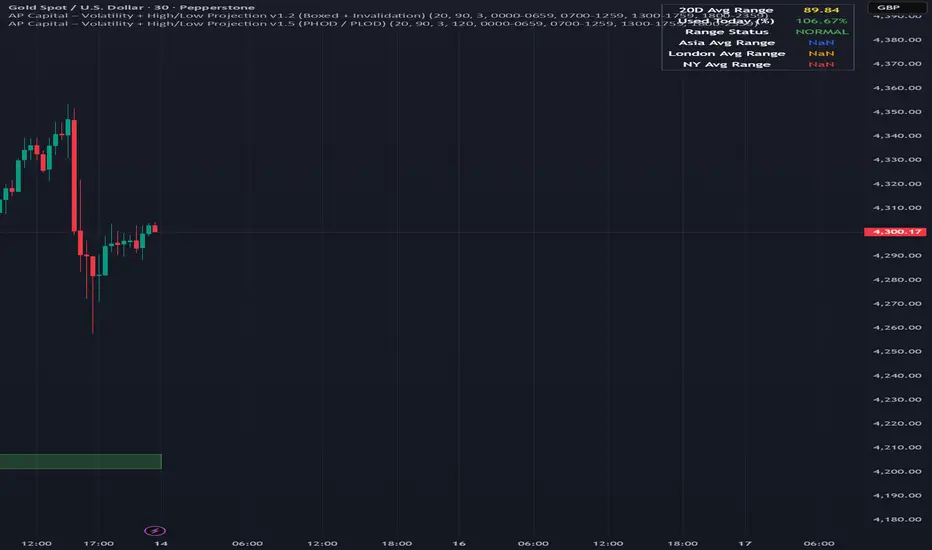
Volatility High/Low Projection (PHOD / PLOD)AP Capital – Volatility + High/Low Projection
This indicator is designed to identify high-probability intraday turning points by combining daily range statistics, session behaviour, and volatility context into a single clean framework.
It is built for index, forex, and metals traders who want structure, not noise.
🔹 Core Features
1️⃣ Potential High of Day (PHOD) & Potential Low of Day (PLOD)
The indicator highlights likely intraday extremes based on:
Session timing (Asia, London, New York)
Current day volatility vs historical averages
Prior day expansion or compression behaviour
Each level is displayed with:
A clear label (PHOD / PLOD)
A forward-extending box acting as a live Point of Interest (POI)
Automatic invalidation when price breaks the zone
2️⃣ Volatility & Range Context (Info Panel)
A compact information panel in the top-right corner provides real-time context without cluttering the chart:
20-Day Average Range
% of the average range already used today
Range status (NORMAL / EXHAUSTED)
Average session ranges for:
Asia
London
New York
This allows traders to immediately assess whether price is:
Early in the day with room to trend
Statistically stretched and prone to reversal
Over-extended where breakout chasing is risky
3️⃣ Session-Aware Logic
The model respects how markets behave across the trading day:
Asia favours accumulation and potential lows
London provides expansion
New York often delivers distribution or exhaustion
This prevents random high/low marking and focuses only on structurally meaningful levels.
🧠 How to Use
Use PHOD / PLOD boxes as reaction zones, not blind entries
Combine with your own confirmation (structure break, momentum, volume, EMA reclaim, etc.)
Avoid chasing trades when the Range Status = EXHAUSTED
Particularly effective on 15m – 1h timeframes
⚠️ Important Notes
This indicator does not repaint
It is contextual, not a buy/sell signal generator
Best used as part of a complete trading plan
📈 Suitable Markets
XAUUSD (Gold)
Indices (NASDAQ, S&P 500, DAX)
Major FX pairs
📌 Disclaimer
This indicator is for educational and analytical purposes only.
It does not constitute financial advice. Trading involves risk.
VCAI BOS-Zone PROVCAI BOS-Zone PRO is a structure-driven order-block mapper that tracks swing highs/lows, detects Break of Structure (BOS), and automatically draws clean bullish and bearish OB zones with midlines and directional flags.
It provides a clear, rules-based map of where structural shifts occurred and where price may react on future retests.
What it does:
Uses configurable swing pivots to define structure.
A bullish BOS is triggered when price closes above the last swing high;
a bearish BOS when price closes below the last swing low.
After each BOS, the script finds the last opposite candle (bearish before a bullish BOS, bullish before a bearish BOS) and builds an order-block zone from that candle’s high/low.
Each zone is projected a fixed number of bars into the future, keeping charts clean and preventing zones from extending into the price scale.
Only the latest N bullish and N bearish zones are kept, so the chart focuses on the most relevant active levels.
How to read it:
Yellow boxes + BULL flags = bullish demand zones.
Purple boxes + BEAR flags = bearish supply zones.
The edges of each zone act as potential support/resistance.
Reactions inside a yellow zone suggest buy-side interest;
rejection at a purple zone suggests sell-side pressure.
Optional midlines mark the 50% level of each zone, commonly used for refined entries, mitigations, and partial management.
How traders typically use it:
BOS-Zone PRO does not generate buy/sell alerts, but many traders use the zones as part of a broader decision process:
Bullish zones are often monitored for long setups when price returns and shows strength or continuation.
Bearish zones are often monitored for short setups when price retests and shows rejection or weakness.
Midlines provide refined entry levels with clearer invalidation points.
This tool is best used as structural context alongside your own entry model, risk settings, and trade management.
Notes & best practices:
BOS is directional, not predictive — treat zones as context, not guaranteed reversals.
Works on all symbols and timeframes.
Lower swing settings capture local structure; higher settings focus on major breaks and cleaner OB's.
Ideal as a structural map for discretionary traders or as a component inside automated systems.
Part of the VCAI toolset.
We develop a range of market-structure, volume, trend and liquidity tools designed to work together or stand alone.

100% Price Action Sequential Multi-TF Break Strategy Analyse 100% sur l'action du prix en regroupant timeframe H1, U15 et U5 sur un seul graphique

Apex IndicatorThe Apex Indicator is a physics-based momentum tool designed to measure the 2nd Derivative (Acceleration) of both Price and Volume.
Unlike standard oscillators which often lag, this indicator uses Kinematics to identify the subtle shifts in momentum before price makes a major move. It answers the critical questions: Is the selling pressure fading? and Is there fresh fuel (Volume) entering to support a turn?
This script uses Hull Moving Average (HMA) smoothing for low-latency calculation, and Z-Score Normalization to force Price and Volume onto a shared, readable scale.
Visual Guide
The Histogram (Price Acceleration)
Bright Green: Strong Bullish Acceleration (High Velocity).
Dark Green: Developing Bullish Momentum (or Waning Bullishness depending on context).
Bright Red: Strong Bearish Acceleration (Panic/Dump).
Dark Red: Developing Bearish Momentum (or Waning Bearishness).
The Line (Volume Acceleration)
Yellow: Volume is accelerating (Interest is entering).
Purple: Volume is decelerating (Interest is leaving).
The Background Highlights
Green/Red Background: These mark Statistical Extremes (>1 Standard Deviation). While these show maximum power, they often mark the climax of a move rather than the start.
How to Trade: Reading the Subtleties
The power of the Apex Indicator is not in chasing the spikes, but in reading the Transitions.
1. The Turn (The Reversal Entry)
Don't wait for the explosion; look for the "braking" action.
The Setup: Price has been moving down strongly (Bright Red bars).
The Signal: The histogram shifts to Dark Red and begins moving up toward the zero line (less negative). This means the selling acceleration is dying.
The Trigger: A Dark Green bar prints, accompanied by the Volume Line turning Yellow/Rising.
Why it works: You are entering when the bearish energy is exhausted and fresh volume is stepping in to lift the price, often before the main breakout occurs.
2. The Second Wind (Trend Continuation)
The Setup: You are already in a trend (Green bars), but the bars fade to Dark Green or near Zero (a pullback or pause).
The Trigger: The next bar flips Bright Green and the Volume Line spikes Yellow.
Why it works: This confirms that the pause was just a breather, and buyers are stepping back on the gas.
3. The "Hollow Move" (Trap Avoidance)
The Scenario: Price is moving up (Green bars), but the Volume Line is Purple or dropping.
Interpretation: This is a drift, not a drive. Without volume acceleration support, these moves are prone to rapid reversal.
4. The Climax (Exits)
If the Background flashes Green (Alert Trigger), be aware that price acceleration has hit a statistical extreme (Z-Score > 1).
If you are in a position, this is often a good place to Take Profit, as maintaining that level of acceleration is mathematically difficult for the market to sustain.
Settings
Analysis Length (21): The lookback period for the HMA smoothing.
Normalization Lookback (21): The historical window used to calculate the Z-Score. A setting of 21 allows the indicator to self-adjust quickly to recent volatility conditions.

PRICE ACTION TRAKKERThis indicator isolates the core price-phase engine from the full Price Action Tracker (PAT) system.
It identifies and visualises structural phases of price, including:
Upper phase boundary (dynamic resistance)
Lower phase boundary (dynamic support)
Phase average (mean-reversion anchor)
Pivot markers (LPH, LPL, oLPH, oLPL)
The phase engine dynamically adapts to evolving market structure using pivot behaviour and structural breaks. This creates a real-time visual map of how price is organising itself — independent of time-based indicators and without the lag associated with classical moving averages.
This version focuses exclusively on price action structure, making it clean, fast, and ideal as a core tool on its own.
However, it is also designed as a foundation for more advanced analysis and will expand over time as additional modules are released.
This phase engine works exceptionally well in combination with my other indicators, such as moving-average structure tools, volume-weighted frameworks, and trend-strength models. Together, they provide a layered view of market behaviour:
phase structure → trend bias → volume confirmation → entry logic.
This makes the indicator valuable for:
Intra-day and swing traders
Wyckoff and liquidity-based traders
Mean-reversion and range-trading strategies
Understanding where accumulation/distribution behaviour is forming
Identifying when a phase is likely ending or breaking
Future updates will add modular expansion paths (trend scoring, VWAP phase weighting, multi-phase confluence, and signal logic), while maintaining the simplicity and reliability of this core engine.
Works Best With:
This indicator is part of a broader toolkit designed to analyse structure, trend, and behaviour.
When used alongside my other published tools — such as trend-strength MAs, VWMA frameworks, and higher-timeframe bias indicators — it provides a complete, multi-layered view of market conditions.

VOLX+ VWAP Range BandsVOLX+ plots multiple VWAP-weighted high/low channels across different lookback periods to show how price behaves relative to short-term and long-term value zones.
Instead of using a single VWAP line, this tool creates four rolling VWAP envelopes:
Short-term range (fast reaction)
Mid-term range
Mid-mid range (transitional layer)
Long-term range (macro context)
Each band is computed as:
VWAP-High = SMA(high × volume, length) ÷ SMA(volume, length)
VWAP-Low = SMA(low × volume, length) ÷ SMA(volume, length)
This produces dynamic price channels that account for both price and traded volume, offering a clearer sense of where the market is accepting or rejecting value.
What It Shows
Four VWAP-weighted high/low bands
A short-term VWAP midline
Price line
Three SMAs for trend context
Optional visibility switches for each VWAP band
The filled regions between VWAP highs and lows create a layered “value map,” helping you interpret:
Trend continuation (price hugging outer VWAP bands)
Mean reversion (price returning toward inner bands)
Volatility contraction/expansion
Shifts in short-term vs long-term balance
🧠 How to Use
Use the short-term band for day-trading context or detecting short-term excess.
Use mid-term and mid-mid bands to confirm developing structure.
Use the long-term VWAP band to understand broader value zones.
Combine VWAP bands with SMAs and structure analysis for confluence.
This indicator is intended for price interpretation and analytical support.
✔ Does Not Repaint
The script uses rolling VWAP formulas and standard MAs; everything is stable and non-repainting.

Liquidation Heatmap [Alpha Extract]A sophisticated liquidity zone visualization system that identifies and maps potential liquidation levels based on swing point analysis with volume-weighted intensity measurement and gradient heatmap coloring. Utilizing pivot-based pocket detection and ATR-scaled zone heights, this indicator delivers institutional-grade liquidity mapping with dynamic color intensity reflecting relative liquidity concentration. The system's dual-swing detection architecture combined with configurable weight metrics creates comprehensive liquidation level identification suitable for strategic position planning and market structure analysis.
🔶 Advanced Pivot-Based Pocket Detection
Implements dual swing width analysis to identify potential liquidation zones at pivot highs and lows with configurable lookback periods for comprehensive level coverage. The system detects primary swing points using main pivot width and optional secondary swing detection for increased pocket density, creating layered liquidity maps that capture both major and minor liquidation levels across extended price history.
🔶 Multi-Metric Weight Calculation Engine
Features flexible weight source selection including Volume, Range (high-low spread), and Volume × Range composite metrics for liquidity intensity measurement. The system calculates pocket weights based on market activity at pivot formation, enabling traders to identify which liquidation levels represent higher concentration of potential stops and liquidations with configurable minimum weight thresholds for noise filtering.
🔶 ATR-Based Zone Height Framework
Utilizes Average True Range calculations with percentage-based multipliers to determine pocket vertical dimensions that adapt to market volatility conditions. The system creates ATR-scaled bands above swing highs for short liquidation zones and below swing lows for long liquidation zones, ensuring zone heights remain proportional to current market volatility for accurate level representation.
🔶 Dynamic Gradient Heatmap Visualization
Implements sophisticated color gradient system that maps pocket weights to intensity scales, creating intuitive visual representation of relative liquidity concentration. The system applies power-law transformation with configurable contrast adjustment to enhance differentiation between weak and strong liquidity pockets, using cyan-to-blue gradients for long liquidations and yellow-to-orange for short liquidations.
🔶 Intelligent Pocket State Management
Features advanced pocket tracking system that monitors price interaction with liquidation zones and updates pocket states dynamically. The system detects when price trades through pocket midpoints, marking them as "hit" with optional preservation or removal, and manages pocket extension for untouched levels with configurable forward projection to maintain visibility of approaching liquidity zones.
🔶 Real-Time Liquidity Scale Display
Provides gradient legend showing min-max range of pocket weights with 24-segment color bar for instant liquidity intensity reference. The system positions the scale at chart edge with volume-formatted labels, enabling traders to quickly assess relative strength of visible liquidation pockets without numerical clutter on the main chart area.
🔶 Touched Pocket Border System
Implements visual confirmation of executed liquidations through border highlighting when price trades through pocket zones. The system applies configurable transparency to touched pocket borders with inverted slider logic (lower values fade borders, higher values emphasize them), providing clear historical record of liquidated levels while maintaining focus on active untouched pockets.
🔶 Dual-Swing Density Enhancement
Features optional secondary swing width parameter that creates additional pocket layer with tighter pivot detection for increased liquidation level density. The system runs parallel pivot detection at both primary and secondary swing widths, populating chart with comprehensive liquidity mapping that captures both major swing liquidations and intermediate level clusters.
🔶 Adaptive Pocket Extension Framework
Utilizes intelligent time-based extension that projects untouched pockets forward by configurable bar count, maintaining visibility as price approaches potential liquidation zones. The system freezes touched pocket right edges at hit timestamps while extending active pockets dynamically, creating clear distinction between historical liquidations and forward-projected active levels.
🔶 Weight-Based Label Integration
Provides floating labels on untouched pockets displaying volume-formatted weight values with dynamic positioning that follows pocket extension. The system automatically manages label lifecycle, creating labels for new pockets, updating positions as pockets extend, and removing labels when pockets are touched, ensuring clean chart presentation with relevant liquidity information.
🔶 Performance Optimization Framework
Implements efficient array management with automatic clean-up of old pockets beyond lookback period and optimized box/label deletion to maintain smooth performance. The system includes configurable maximum object counts (500 boxes, 50 labels, 100 lines) with intelligent removal of oldest elements when limits are approached, ensuring consistent operation across extended timeframes.
This indicator delivers sophisticated liquidity zone analysis through pivot-based detection and volume-weighted intensity measurement with intuitive heatmap visualization. Unlike simple support/resistance indicators, the Liquidation Heatmap combines swing point identification with market activity metrics to identify where concentrated liquidations are likely to occur, while the gradient color system instantly communicates relative liquidity strength. The system's dual-swing architecture, configurable weight metrics, ATR-adaptive zone heights, and intelligent state management make it essential for traders seeking strategic position planning around institutional liquidity levels across cryptocurrency, forex, and futures markets. The visual heatmap approach enables instant identification of high-probability reversal zones where cascading liquidations may trigger significant price reactions.

(QUANTLABS) Fractal God Mode: 25-Timeframe Scanner The indicator aggregates data into three distinct metric columns:
1. STRUCT (Market Structure) This analyzes price action relative to Fractal Pivots (Highs and Lows) to determine market direction.
HH (Breakout): Price has closed above the previous Pivot High. (Bullish Structure)
LL (Breakdown): Price has closed below the previous Pivot Low. (Bearish Structure)
TRAPPED: Price is trading between the last Pivot High and Low. This indicates a ranging market where trend trades should be avoided.
2. VELOCITY (Thrust) This measures the specific strength of the current candle on that timeframe.
The Math: It calculates the ratio of the body (Close - Open) relative to the total candle range (High - Low).
The Signal: High positive numbers (Green) indicate buyers are closing near highs. High negative numbers (Red) indicate sellers are dominating the range.
3. QUALITY (Efficiency Ratio) This acts as a "Noise Filter." It determines if the trend is moving in a straight line or whipping back and forth.
The Math: It divides the Net Price Movement (Distance from 5 bars ago) by the Total Path Traveled (Sum of the ranges of the last 5 bars).
PRISTINE (Values > 0.6): The market is moving efficiently in one direction.
CHOPPY (Values < 0.4): The market is volatile and non-directional (High Noise).
1. The Matrix (Dashboard) Located in the bottom right, this table gives you an instant read on Short-Term (3m-9m), Medium-Term (10m-45m), and Long-Term (1H-Daily) trends.
2. Coherence Flow At the bottom of the table, the script sums up the structural score of all 25 timeframes.
COHERENT BULL: When the Short, Medium, and Long terms align green.
COHERENT BEAR: When the Short, Medium, and Long terms align red.
3. God Mode (Global S/R) The indicator can plot Support and Resistance levels from higher timeframes onto your current chart. For example, while trading the 5m chart, you can see the 4H and Daily pivot levels plotted automatically as dotted lines, ensuring you never trade blindly into a higher-timeframe wall.
Trend Following: Wait for the "Coherent Bull/Bear" signal at the bottom of the dashboard. This confirms that momentum is aligned from the 3m chart up to the Daily.
Scalping: Focus on the Quality column. Only take trades when the Quality is "CLEAN" or "PRISTINE." Avoid entries when the dashboard warns of "High Noise" (Choppy).
Risk Management: If the dashboard shows "TRAPPED" on the Long Term (1H+), reduce position size or wait for a breakout.
Pivot Lookback: Adjusts the sensitivity of the Fractal Structure (Default: 5).
Show Fractal DNA Matrix: Toggles the dashboard table.
Show ALL Timeframe S/R: Enables "God Mode" to see supports/resistances from all 25 timeframes (Heavy visual processing, use carefully).

Future High LinePlot a horizontal line from the current high n bars into the future. Line is user configurable.
Works well with Ichimoku Cloud. When line (26 bars) rises into an overhead cloud, this often signals bullish price movement.

PA Base IndicatorsPA Base Indicators(Price Action)
1. EMA 20
2. EMA 240
3. Bar Count
4. IBS > 69 || IBS < 31
