OPEN-SOURCE SCRIPT
已更新 Falling-Rising Filter
Introduction
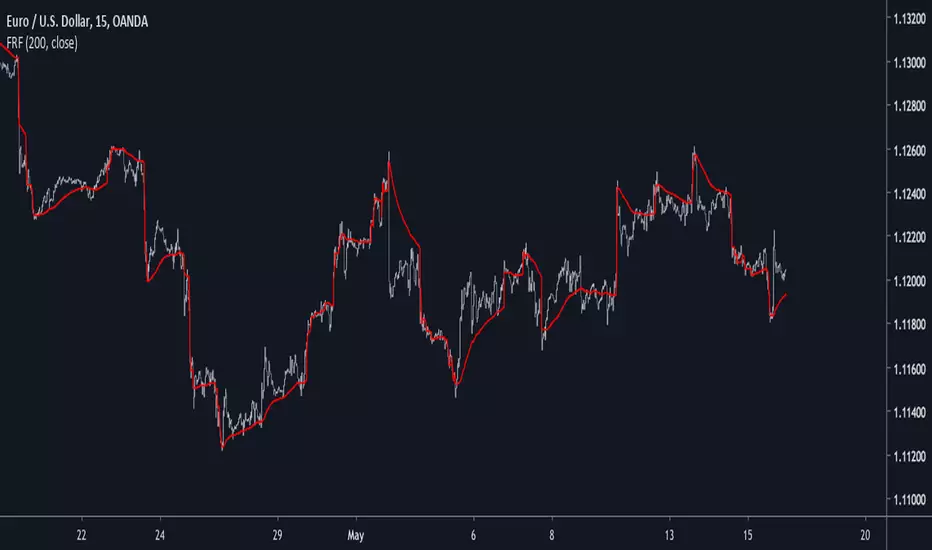
This is a modification of an old indicator i made. This filter aim to adapt to market trend by creating a smoothing constant using highest and lowest functions. This filter is visually similar to the edge-preserving filter, this similarity can make this filter quite good for MA cross strategies.
On The Filter Code
a = nz(a[1]) + alpha*nz(error[1]) + beta*nz(error[1])
The first 3 terms describe a simple exponential filter where error = price - a, beta introduce the adaptive part. beta is equal to 1 when the price is greater or lower than any past price over length period, else beta is equal to alpha, someone could ask why we use two smoothing variable (alpha, beta) instead of only beta thus having :
a = nz(a[1]) + beta*nz(error[1])
well alpha make the filter converge faster to the price thus having a better estimation.

In blue the filter using only beta and in red the filter using alpha and beta with both length = 200, the red filter converge faster to the price, if you need smoother results but less precise estimation only use beta.
Conclusion
I have presented a simple indicator using rising/falling functions to calculate an adaptive filter, this also show that when you create an exponential filter you can use more terms instead of only a = a[1] + alpha*(price - a[1]). I hope you find this indicator useful.
Thanks for reading !
This is a modification of an old indicator i made. This filter aim to adapt to market trend by creating a smoothing constant using highest and lowest functions. This filter is visually similar to the edge-preserving filter, this similarity can make this filter quite good for MA cross strategies.
On The Filter Code
a = nz(a[1]) + alpha*nz(error[1]) + beta*nz(error[1])
The first 3 terms describe a simple exponential filter where error = price - a, beta introduce the adaptive part. beta is equal to 1 when the price is greater or lower than any past price over length period, else beta is equal to alpha, someone could ask why we use two smoothing variable (alpha, beta) instead of only beta thus having :
a = nz(a[1]) + beta*nz(error[1])
well alpha make the filter converge faster to the price thus having a better estimation.
In blue the filter using only beta and in red the filter using alpha and beta with both length = 200, the red filter converge faster to the price, if you need smoother results but less precise estimation only use beta.
Conclusion
I have presented a simple indicator using rising/falling functions to calculate an adaptive filter, this also show that when you create an exponential filter you can use more terms instead of only a = a[1] + alpha*(price - a[1]). I hope you find this indicator useful.
Thanks for reading !
發行說明
Fixed a redundant error, thanks to aaahopper for pointing it out.開源腳本
秉持TradingView一貫精神,這個腳本的創作者將其設為開源,以便交易者檢視並驗證其功能。向作者致敬!您可以免費使用此腳本,但請注意,重新發佈代碼需遵守我們的社群規範。

Check out the indicators we are making at luxalgo: tradingview.com/u/LuxAlgo/
"My heart is so loud that I can't hear the fireworks"
"My heart is so loud that I can't hear the fireworks"
免責聲明
這些資訊和出版物並非旨在提供,也不構成TradingView提供或認可的任何形式的財務、投資、交易或其他類型的建議或推薦。請閱讀使用條款以了解更多資訊。
開源腳本
秉持TradingView一貫精神,這個腳本的創作者將其設為開源,以便交易者檢視並驗證其功能。向作者致敬!您可以免費使用此腳本,但請注意,重新發佈代碼需遵守我們的社群規範。
Check out the indicators we are making at luxalgo: tradingview.com/u/LuxAlgo/
"My heart is so loud that I can't hear the fireworks"
"My heart is so loud that I can't hear the fireworks"
免責聲明
這些資訊和出版物並非旨在提供,也不構成TradingView提供或認可的任何形式的財務、投資、交易或其他類型的建議或推薦。請閱讀使用條款以了解更多資訊。