Stochastique Divergences IndicatorHello,
I made a custom indicator.
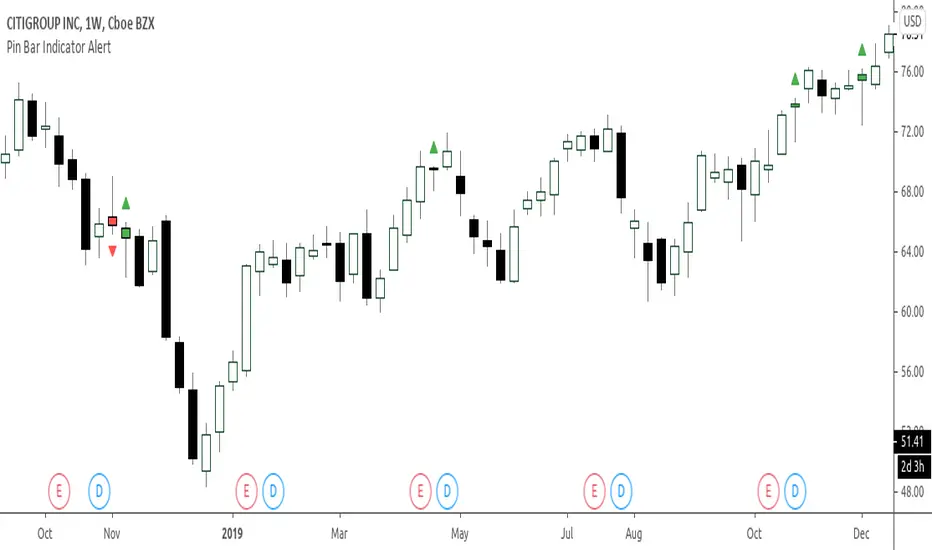
Divergences with stochastique and price are really strong signals.
About the indicator
A bullish divergence happens when the stoch K makes a higher low and is depicted by a green triangle up.
A bearish divergence happens when the stoch K makes a lower high and is depicted by a red triangle down.
This script is the base for my next strategy that I should upload soon.
I will grant access (to this script and my others) to people willing to make a small donation.
Here is my BTC address : 19sVQvCDmVfEACq7BiMnWSMqFPZ8qfSQ2K
If you prefer ETH : 0xc8a5d3a63a05db0c2363ea1c08b37a01cce9ebfb
Send me a Private Message with the ID of the transaction
If you want to do some forward testing first, send me a message.
Also check blockchainfiesta.com
在腳本中搜尋"bear"
wTF50This is a customized trend filter that has several uses:
It helps identify trend direction, either bullish or bearish
It distinguishes between a pullback and a trend reversal
It helps identify areas where traders should stand aside
It highlights areas of consolidation
dTF50This is a customized trend filter that has several uses:
It helps identify trend direction, either bullish or bearish
It distinguishes between a pullback and a trend reversal
It helps identify areas where traders should stand aside
It highlights areas of consolidation
OBV divergence hidden and regular on both bearish and bullish.OBV (on balance volume) divergence indicator with hidden and regular signal on both bearish and bullish.
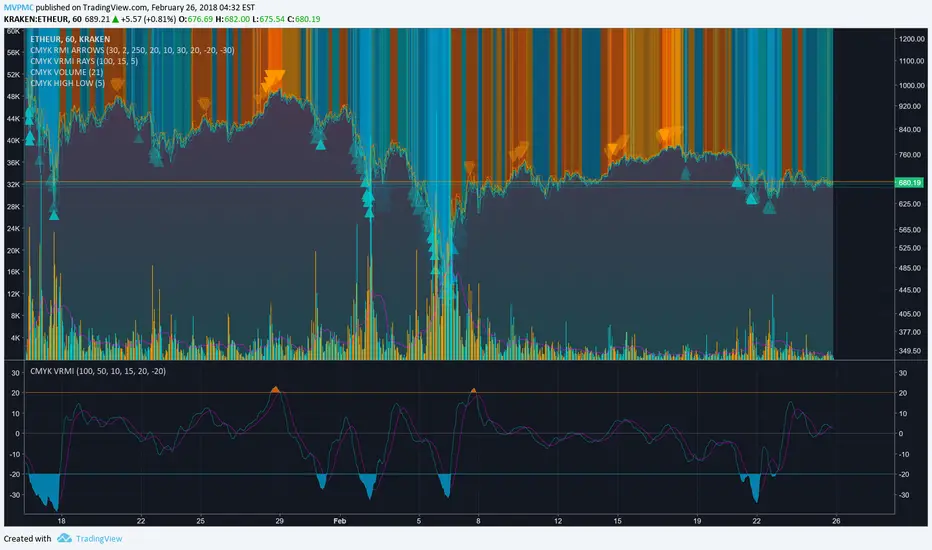
CMYK VRMI◊ Introduction
This script indicates the relative movement of price x volume.
◊ Origin
Based on 'The Relative Momentum Index' by Roger Altman : February, 1993 issue of Technical Analysis of Stocks & Commodities magazine.
While RSI counts up and down days from close to close, the Relative Momentum Index counts up and down days from the close relative to a close x number of days ago.
This results in an RSI that is smoother. The input has been changed to the change of a smoothed close multiplied by a smoothed volume.
The polarity of VRMI indicates bearish/bullish movement.
◊ Adjustments
CMYK color theme applied.
◊ Usage
VRMI indicates the force the market moves with.
◊ Future Prospects
-
◊ ◊ ◊ ◊ ◊ ◊ ◊ ◊ ◊ ◊ ◊ ◊ ◊ ◊ ◊ ◊ ◊ ◊ ◊ ◊ ◊ ◊ ◊ ◊ ◊ ◊ ◊ ◊ ◊ ◊ ◊ ◊ ◊ ◊ ◊ ◊ ◊ ◊ ◊ ◊ ◊ ◊ ◊ ◊ ◊ ◊ ◊ ◊ ◊ ◊ ◊ ◊ ◊ ◊ ◊ ◊ ◊ ◊ ◊ ◊ ◊ ◊ ◊ ◊ ◊ ◊ ◊ ◊ ◊ ◊ ◊ ◊ ◊ ◊ ◊ ◊ ◊ ◊ ◊ ◊ ◊ ◊ ◊ ◊ ◊ ◊ ◊ ◊ ◊ ◊ ◊ ◊ ◊ ◊ ◊ ◊ ◊ ◊ ◊ ◊ ◊ ◊ ◊ ◊ ◊ ◊
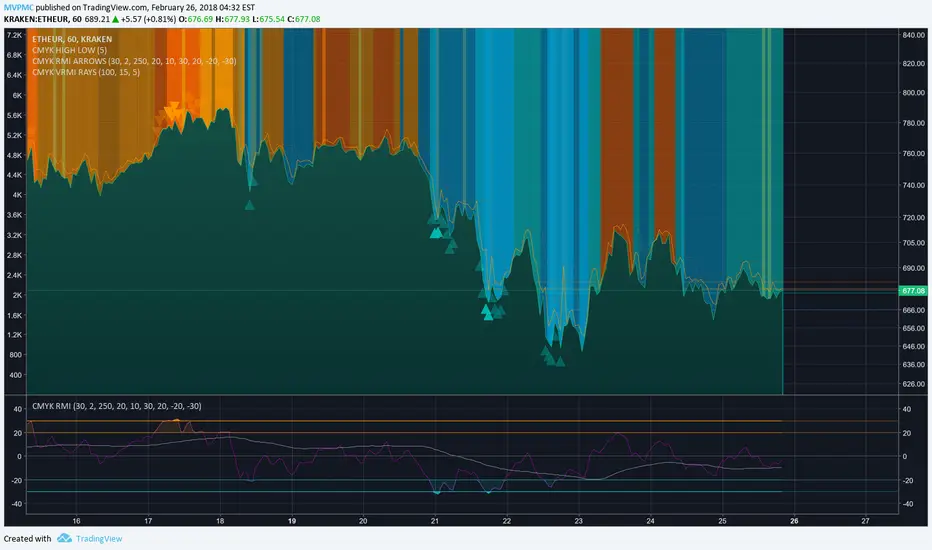
CMYK VRMI RAYS ◊ Introduction
Introducing VRMI in this script, an RMI based on price movement and volume, to indicate bullish and bearish trends.
This script marks the background depending on RMI <> VRMI , VRMI polarity and large buy/sell sprees.
◊ Origin
Based on 'The Relative Momentum Index' by Roger Altman : February, 1993 issue of Technical Analysis of Stocks & Commodities magazine.
While RSI counts up and down days from close to close, the Relative Momentum Index counts up and down days from the close relative to a close x number of days ago.
This results in an RSI that is smoother.
In addition VRMI reacts quick, it is used to cut off latency from RMI, and it's polarity indicates the beginning and end of a trend.
Large buy sell sprees and detected in their proportion with an sma on the volume
◊ Adjustments
CMYK color theme applied.
◊ Usage
This indicator can be used to detect trends and mark reversals.
◊ Prospects
◊ ◊ ◊ ◊ ◊ ◊ ◊ ◊ ◊ ◊ ◊ ◊ ◊ ◊ ◊ ◊ ◊ ◊ ◊ ◊ ◊ ◊ ◊ ◊ ◊ ◊ ◊ ◊ ◊ ◊ ◊ ◊ ◊ ◊ ◊ ◊ ◊ ◊ ◊ ◊ ◊ ◊ ◊ ◊ ◊ ◊ ◊ ◊ ◊ ◊ ◊ ◊ ◊ ◊ ◊ ◊ ◊ ◊ ◊ ◊ ◊ ◊ ◊ ◊ ◊ ◊ ◊ ◊ ◊ ◊ ◊ ◊ ◊ ◊ ◊ ◊ ◊ ◊ ◊ ◊ ◊ ◊ ◊ ◊ ◊ ◊ ◊ ◊ ◊ ◊ ◊ ◊ ◊ ◊ ◊ ◊ ◊ ◊ ◊ ◊ ◊ ◊ ◊ ◊ ◊ ◊
Bullish and Bearish Engulfing Patterns auto detectionThis simple indicator detects automatically most important bullish and bearish candlestick patterns formations. Used to locate potential supply and demand imbalances.
Copyright 2017 Alfonso Moreno www.set-and-forget.com
Super Envolvente (Bullish y Bearish)Identificador de Super-envolventes (SE), se encarga de darle un color verde a la SE alzista (Bullish) verde y rojo a la bajista (Bearish).
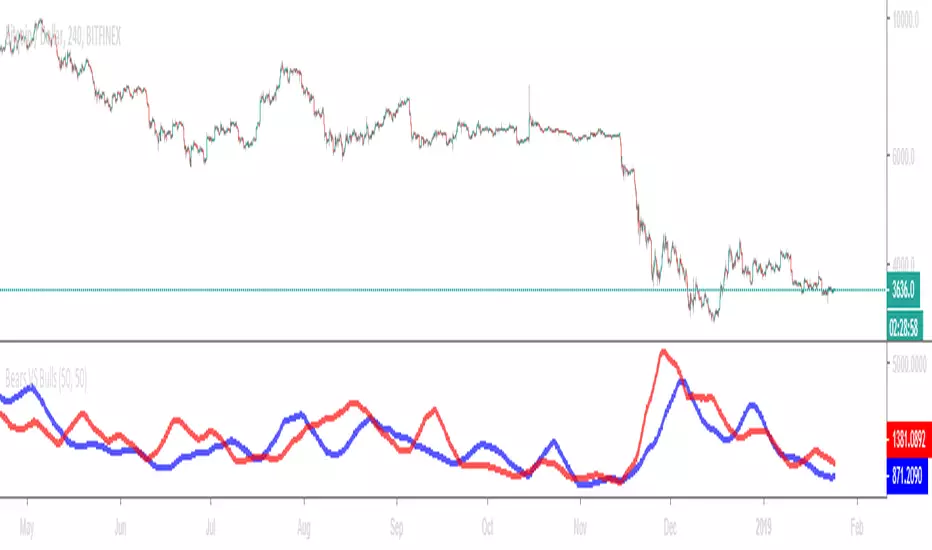
Bears VS BullsThis indicator will work on ANY instrument.
The red line is a moving average of ONLY sellers in the market.
The blue line is a moving average of ONLY buyers in the market.
The period or "length" of the individual moving averages can be adjusted in the indicator settings.
The default, it is set to 50.
Buying and selling trends often provide indications of market moves such as the most recent bottom in Cryptocurrencies.
Feel free to comment and share any indicator concepts or ideas for content you would like to see added to the Technical Indicator Bundle on www.kenzing.com
Bearish Trailing stopIt is a trailing SL. Works very well. Good good very good. Looks like my description needs more, so here is more random text.
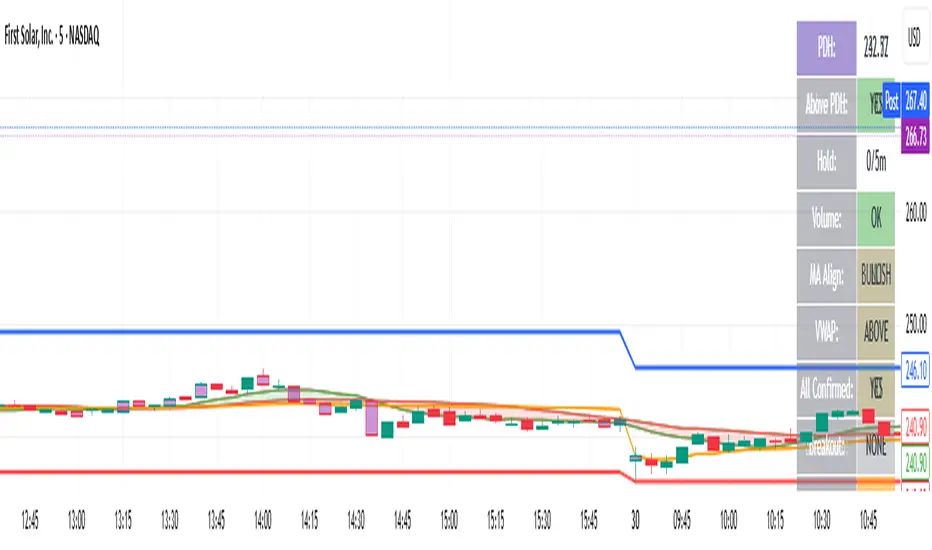
bearish Price Below PDL - Complete Multi-Confirmation Alert🎯 KEY IMPROVEMENTS:
1. Enhanced Alert Visibility:$jmoskyhigh
✅ HUGE triangle down marker with "SELL" text
✅ Alert title: "SELL SIGNAL - PDL BREAKDOWN CONFIRMED"
✅ Prominent info panel with red theme
✅ Clear "SELL ALERT: TRIGGERED" status
2. Better Visual Feedback:
Red frame around info panel
Larger shapes and markers
Color-coded confirmations (green = OK, red = FAIL)
Progress percentage displayed
Breakdown price label
3. Complete Alert System:
Main Alert: "SELL SIGNAL - PDL BREAKDOWN CONFIRMED"
Early Warning: "PDL Breakdown Started - Monitoring"
Reset Alert: "Confirmation Lost - Breakdown Reset"
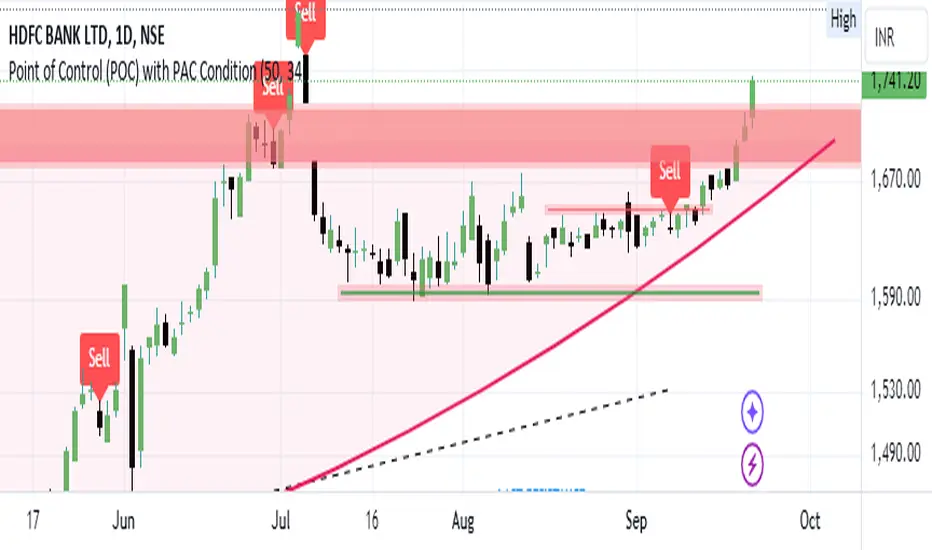
Bearish signal using Point of Control (POC) with PAC by guruThis indicator code helps traders identify potential sell opportunities using several important technical indicators:
Point of Control (POC) – This is the price level where the most volume was traded over the past several days.
Previous Day's Low – This shows the lowest price reached during the previous day.
PAC (Price Action Channel) EMA – These are two moving averages (one based on the low price and one based on the close price) that help determine if the price is trending within a certain range.
Volume SMA – This is a 3-day simple moving average (SMA) of volume, which helps filter out signals based on market activity.
What the Script Does:
Point of Control (POC):
The script looks at the last 50 days (configurable) and calculates which price level had the highest trading volume.
It then plots a red line on the chart at the POC level. This is important because it helps identify areas where there was strong market interest in the past.
Volume Moving Average:
The script calculates a 3-day SMA of volume, but it excludes the current day to avoid premature signals based on today’s trading.
The volume SMA is used to ensure there’s enough market activity (with a threshold set to 25 units) before triggering a sell signal.
Price Action Channel (PAC) EMA:
The PAC consists of two exponential moving averages (EMAs):
The PAC Low EMA: This is based on the low prices over the last 34 periods (configurable).
The PAC Close EMA: This is based on the closing prices over the last 34 periods.
These EMAs help determine if the price is trending above or below certain price levels.
Sell Signal Logic: The script checks three conditions before displaying a "Sell" signal:
Price Below POC and Previous Day’s Low:
The close price must be below both the Point of Control (POC) and the previous day's low.
Volume SMA Above 25:
The 3-day volume SMA must be greater than 25. This ensures the signal only triggers when there’s enough trading volume in the market.
Today’s Low is Above PAC EMAs:
Today's low price must be above both the PAC low EMA and the PAC close EMA. This prevents sell signals when prices are already significantly below the PAC, indicating possible exhaustion in the downtrend.
If all three conditions are met, the script will display a red "Sell" label on the chart, signaling a potential selling opportunity.
No Sell Signal if Price Reverses:
If the price crosses back above the POC or the previous day's low, the script will remove the sell signal and reset for a new opportunity.
Summary of Conditions:
For the script to display a "Sell" label:
The close price must be below the Point of Control (POC) and the previous day’s low.
The 3-day volume SMA (excluding today) must be greater than 25 units.
The low price of the current day must be above both the PAC low EMA and the PAC close EMA.
If these conditions are met, a red sell label appears on the chart as a potential signal for a short (sell) trade.
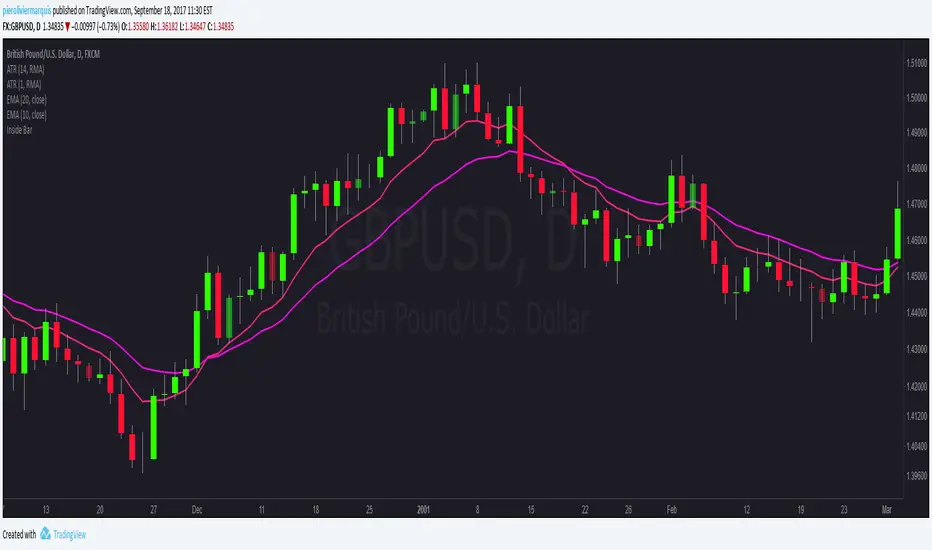
Bearish FS Continuation S1BB - baby bar / inside bar
DF - downflow, meaning 20MA below 50MA
EXE - execution bar, indicator to short
Mainly to identify execution bar for shorting using inside bar identification and force top
Guneet-ScalperBearish trend candle color change to red with sell print
Bullish trend candle color change to green with buy print
thanks
jas toor
Supertrend Elite Trend System🏆 SUPERTREND ELITE TREND SYSTEM (SETS)
A sophisticated multi-indicator voting system designed for crypto trending markets, combining 10 powerful technical indicators with weighted scoring and trend confirmation.
📊 BACKTESTED PERFORMANCE (2018-2026):
- Total Return: +2,170%
- Win Rate: 30.23%
- Profit Factor: 2.4
- Max Drawdown: 41.72%
- Total Trades: 43
🎯 HOW IT WORKS:
The system uses 10 carefully selected indicators that "vote" on market direction:
1. Supertrend - Trend following baseline
2. ALMA - Smooth trend detection (Weight: 2)
3. CTI - Correlation Trend Indicator
4. STC - Sebastine Trend Catcher (Weight: 2)
5. GUNXO - Dual EMA trend sniper
6. DEMA DMI - Combined momentum & trend (Weight: 2)
7. MM - Market momentum indicator
8. DMI Loop - Directional movement analysis
9. Trend Oscillator - Fast/slow EMA divergence
10. Stochastic - Overbought/oversold conditions
Each indicator votes BULL (+1 or +2) or BEAR (-1 or -2), creating a weighted score out of 13 possible points.
🔥 SIGNAL GENERATION:
- STRONG BULL: Score difference > +4 (sustained 2 bars)
- WEAK BULL: Score difference > +1 (sustained 2 bars)
- WEAK BEAR: Score difference < -1 (sustained 2 bars)
- STRONG BEAR: Score difference < -4 (sustained 2 bars)
The 2-bar confirmation requirement filters out false signals and reduces whipsaws.
💎 BEST FOR:
- Crypto markets (BTC, ETH, major altcoins)
- 4H to Daily timeframes
- Trending markets (bull or bear)
- Long-term position holders
⚠️ NOT RECOMMENDED FOR:
- Ranging/sideways markets
- Scalping or day trading
- Low-volume altcoins
- High-frequency trading
📈 VISUAL FEATURES:
- Color-coded trend line below price (Green = Bull, Red = Bear)
- Real-time score dashboard showing bull/bear votes
- Clear action signals (BUY/HOLD, CAUTION, REDUCE, SELL/EXIT)
- Built-in alerts for trend changes
💡 STRATEGY:
The system is designed for "buy and hold during uptrends" approach. Enter on STRONG BULL or WEAK BULL signals, exit on WEAK BEAR or STRONG BEAR signals. Works best when combined with proper risk management and position sizing.
📱 ALERTS AVAILABLE:
- Strong Buy Signal
- Strong Sell Signal
- Trend Weakening Warning
- Bearish Turn Warning
Created and backtested by advanced algorithmic trading research. Not financial advice - always do your own research and never risk more than you can afford to lose.
FVG in Order Blocks Indicator📊 FVG in Order Blocks — Context-Based Fair Value Gap Analysis
This indicator is designed to study Fair Value Gaps (FVGs) only when they appear within meaningful market structure zones, specifically Order Blocks and Breaker Blocks.
Instead of treating imbalances in isolation, the script focuses on context — highlighting situations where price imbalance and structure align.
The objective is analytical clarity, not prediction.
🧠 Core Idea
Fair Value Gaps often indicate rapid price movement and potential inefficiencies.
Order Blocks and Breaker Blocks are commonly used to represent areas where price previously reacted with strength.
This script combines both concepts by restricting FVG detection to structurally relevant zones, allowing users to observe how imbalance behaves when it forms in areas already defined by market structure.
🔍 How the Indicator Works
The logic follows a clear, step-by-step process:
🧱 1. Market Structure & Zone Detection
Market swings are derived using a ZigZag-based structure model
From these swings, the script identifies:
Bullish & Bearish Order Blocks
Bullish & Bearish Breaker Blocks
These zones define where FVGs are considered relevant
Only gaps forming inside these zones are evaluated further.
⚡ 2. Fair Value Gap Detection
Bullish and bearish FVGs are detected using confirmed candle logic
No future data or lookahead is used
Optional Consequent Encroachment (midpoint) levels can be plotted for reference
This ensures gaps are identified objectively and consistently.
🔗 3. Confluence Validation
A visual signal is evaluated only when:
An FVG forms
The FVG is inside an active Order Block or Breaker Block
This alignment helps users focus on areas where structure and imbalance overlap, rather than every gap on the chart.
📌 Signal Visualization (Informational Only)
Signals are shown as chart markers and are intended for analysis, not automated execution.
🟢 Bullish Condition
Price is inside a bullish Order Block or Breaker Block
A bullish FVG forms within that zone
The gap is confirmed after candle close
🔴 Bearish Condition
Price is inside a bearish Order Block or Breaker Block
A bearish FVG forms within that zone
The gap is confirmed after candle close
🧪 Optional Filters (User-Controlled)
All filters are optional and can be enabled or disabled independently:
📈 Trend Filter
Market Structure bias
EMA-based methods (EMA 50, EMA 200, EMA cross)
⚡ Displacement Filter
Requires momentum before an FVG is accepted
Based on ATR multiples or candle body percentage
📏 Minimum FVG Size Filter
Ignores very small gaps that may represent noise
Size measured using ATR %, ticks, or price value
⏱ Cooldown Filter
Limits how frequently signals can appear
Helps reduce clustering during ranging conditions
🎨 Visual & Layout Options
Order Blocks and Breaker Blocks drawn as colored zones
Fair Value Gaps displayed as shaded areas
Optional Consequent Encroachment lines
Optional EMAs used by trend filters
Optional markers showing when a setup was filtered out
Timeframe presets are included to adjust sensitivity for common intraday charts, while still allowing full manual customization.
🎯 Intended Use
This indicator is intended for:
Studying price imbalance within structure
Learning how FVGs interact with Order Blocks and Breaker Blocks
Manual trade planning and journaling
Backtesting and educational analysis
It can be applied to Forex, Crypto, Indices, Stocks, and Commodities across multiple timeframes.
ℹ️ Important Notes
Signals are non-repainting and based on confirmed bars
The script does not place trades or manage risk
No performance claims are made
Outcomes depend on market conditions and user interpretation
⚠️ Disclaimer
This script is provided for educational and analytical purposes only.
It does not constitute financial, investment, or trading advice.
Trading involves risk, and users should apply appropriate risk management and independent judgment.
PVSRA Candles - [CT]✅ Primary Categories (Best Fit)
1. Volume
The indicator is fundamentally based on volume expansion and participation analysis.
This is the strongest and most accurate primary category.
2. Candles / Chart Style
Your script visually modifies candle appearance and replaces default candle coloring.
Fits TradingView’s candle visualization and price presentation tools.
✅ Secondary Supporting Categories
3. Price Action
The indicator interprets institutional activity through price + volume relationship.
Helps traders analyze liquidity, accumulation, and distribution behavior.
4. Market Structure / Institutional Concepts
(Not an official TV category name but often accepted under Price Action or Other.)
PVSRA methodology aligns with smart money and institutional participation concepts.
✅ Optional Categories (Situational Fit)
You could justify these depending on your publish description:
5. Support & Resistance
PVSRA is often used around liquidity zones and reaction levels.
Not the core function, so this should be secondary if used.
6. Other
Sometimes used when an indicator blends multiple methodologies.
⭐ Recommended Category Selection Order (Best for Visibility)
If TradingView allows multiple selections:
Volume (Primary)
Candles
Price Action
📊 TradingView Tag Suggestions (Highly Recommended)
These help search ranking and discoverability:
PVSRA
Volume Analysis
Smart Money
Institutional Trading
Candle Coloring
Liquidity
Volume Spread Analysis
Market Participation
📊 Institutional Overview
PVSRA Candles – is an institutional-style volume and price action visualization tool based on Price, Volume, Support, Resistance Analysis (PVSRA) methodology. This indicator enhances standard candlestick charts by dynamically recoloring candles according to volume intensity and directional pressure, helping traders identify potential institutional activity, liquidity events, and momentum shifts.
The tool focuses on identifying abnormal volume behavior relative to recent market activity. By combining candle structure with volume expansion metrics, traders can more effectively interpret accumulation, distribution, and potential market manipulation commonly associated with smart money activity.
This indicator is designed to assist traders in recognizing when participation significantly increases, which often precedes major price moves or reversals.
🔍 Core Concepts Behind the Indicator
Institutional participants typically operate using large order sizes that cannot be executed instantly without affecting price. These participants often accumulate or distribute positions during periods of increased liquidity. PVSRA attempts to highlight these moments by analyzing:
• Relative volume spikes
• Candle spread combined with volume
• Directional price intent
• Cross-instrument volume referencing (optional)
By classifying candles into volume strength tiers, traders gain insight into whether current price movement is supported by strong participation or weaker market activity.
⚙️ How The Indicator Works
The indicator calculates average volume using a short-term baseline and compares current volume against that baseline. Candle classification is then assigned based on volume expansion and price movement.
Volume Strength Classification
🔴 200% Volume Candles (Ultra High Activity)
• Volume is at least 200% of recent average OR
• Volume multiplied by candle range reaches highest recent levels
• Often signals strong institutional participation
• May indicate breakout continuation or climax/exhaustion zones
🔵 150% Volume Candles (High Activity)
• Volume reaches approximately 150% of recent average
• Suggests increasing participation
• Often occurs during early momentum phases or liquidity sweeps
⚪ Normal Volume Candles
• Volume remains within typical market range
• Represents standard market participation
• Often seen during consolidation or low volatility periods
Each classification is visually represented through customizable bullish and bearish color schemes.
🎯 Key Features
✅ Institutional-style PVSRA candle coloring
✅ Dynamic volume expansion detection
✅ Optional candle override visualization
✅ Cross-symbol volume referencing
✅ Fully customizable color themes
✅ Lightweight overlay for clean chart integration
🔄 Cross-Instrument Volume Analysis
The indicator includes an optional symbol override feature that allows traders to analyze volume from another instrument while viewing price on their current chart.
This is commonly used in correlated markets such as:
• Futures vs Spot markets
• Index vs Individual equities
• Perpetual futures vs underlying asset
• Cross-exchange liquidity comparison
This feature can help traders detect hidden participation or liquidity flow that may not appear on the active chart alone.
🛠 Settings Guide
Switch Board
PVSRA Toggle
Enables or disables the PVSRA overlay entirely.
Candle Override
Override Candles with PVSRA Color
Replaces standard TradingView candles with PVSRA-colored candles.
For best visualization, drag the indicator to the top of the Object Tree.
Symbol Override
Override Symbol
Enables volume referencing from a different trading instrument.
Symbol Selector
Choose the instrument used for volume calculations.
Price remains based on the active chart.
Color Customization
Separate color settings are available for:
• 200% Volume Bullish / Bearish Candles
• 150% Volume Bullish / Bearish Candles
• Normal Volume Bullish / Bearish Candles
These allow traders to tailor visualization to their trading style or chart theme.
📈 How Traders Commonly Use PVSRA
1. Liquidity Sweep Detection
High-volume candles appearing near swing highs or lows can indicate liquidity grabs or stop runs often executed by large participants.
2. Breakout Confirmation
Strong volume expansion during range breakouts can help confirm institutional participation and reduce false breakout risk.
3. Reversal Identification
Climactic volume spikes after extended trends may signal exhaustion and potential reversals.
4. Trend Strength Analysis
Sustained high-volume candles in trend direction typically reflect strong directional commitment.
🧠 Best Practices
• Combine with market structure analysis
• Use alongside support and resistance zones
• Monitor session-based liquidity periods
• Avoid interpreting single candles in isolation
• Focus on clusters of high-volume candles for confirmation
⚠️ Important Notes
• This indicator does not provide direct buy or sell signals.
• PVSRA is intended as a volume participation analysis tool.
• Results may vary across markets depending on volume data quality.
• Cross-symbol referencing requires instruments with meaningful correlation.
📊 Recommended Markets & Timeframes
The indicator is designed to work across multiple markets including:
• Forex
• Futures
• Cryptocurrencies
• Equities
• Indices
Works effectively across scalping, intraday, and swing trading environments.
📜 License & Usage
This script is licensed under CC BY-NC-SA 4.0.
You may:
✔ Share and adapt the script
✔ Modify for personal or educational use
You may NOT:
❌ Use for commercial resale
❌ Redistribute without attribution
❌ Remove license or author credit
🤝 Credits
Developed by CalmsTrades
Multi VWAP with Separate Bands (D / W / M) - YSR TRIDENT FX🧠 How to Trade by Combining Daily + Weekly + Monthly VWAP
Think of VWAP as fair value on different timeframes.
When all three align, probability increases.
🧭 3-Layer VWAP Framework (Very Important)
🗓 Monthly VWAP → Market Environment
Defines big picture bias
Price above Monthly VWAP → Long-term bullish
Price below Monthly VWAP → Long-term bearish
👉 Trade only in the direction of Monthly VWAP
📆 Weekly VWAP → Swing Control
Defines medium-term control
Acts as dynamic support / resistance
Strong trends hold above (bull) or below (bear)
👉 Use Weekly VWAP as decision line
⏱ Daily VWAP → Execution Zone
Used for entries & exits
Daily VWAP bands = intraday discount / premium
Best entries happen near Daily bands in HTF direction
✅ High-Probability BUY Setup (All 3 Aligned)
✔ Price above Monthly VWAP
✔ Weekly VWAP acting as support
✔ Pullback into Daily lower band
✔ Strong bullish candle / rejection
🎯 Target:
Daily VWAP
Daily upper band
🛑 Stop-loss:
Below Daily swing low
❌ Avoid Buys When
❌ Price below Monthly VWAP
❌ Weekly VWAP overhead resistance
❌ Price stuck between VWAPs (no direction)
🔴 High-Probability SELL Setup (All 3 Aligned)
✔ Price below Monthly VWAP
✔ Weekly VWAP acting as resistance
✔ Pullback into Daily upper band
✔ Bearish rejection candle
🎯 Target:
Daily VWAP
Daily lower band
🛑 Stop-loss:
Above Daily swing high
📊 Band Interaction Logic (Advanced)
🔹 Daily band → Entry timing
🔹 Weekly band → Swing targets
🔹 Monthly band → Extreme exhaustion zone
The more VWAPs that overlap, the stronger the level.
🧩 VWAP Stacking (Very Powerful Concept)
📈 Bullish Stack
Price
↑
Daily VWAP
Weekly VWAP
Monthly VWAP
📉 Bearish Stack
Monthly VWAP
Weekly VWAP
Daily VWAP
↓
Price
➡ Stacked VWAPs = trend strength
💡 Pro Tips
✔ Best trades come from Weekly / Monthly VWAP reactions
✔ Avoid trades in middle zone (between bands)
✔ VWAP alignment works best with volume expansion
✔ One good VWAP trade > many random trades
⚠️ Risk Reminder
This is not a signal generator.
Always confirm with price action & risk management.
TrendFib Pro [KhedrFX]Automatic Fibonacci Indicator for TradingView: Real-Time Retracement, Extension & XABC Pattern Tool
TrendFib Pro is a powerful automatic Fibonacci indicator for TradingView that detects recent swing highs and lows in real time to plot precise Fibonacci retracement and extension levels. It combines dynamic swing identification with standard Fibonacci ratios and projects an XABC pattern structure — highlighting key B retracement zones (0.382 or 0.5) and a forward dashed C target — to reveal high-probability confluence areas for trend continuations, pullbacks, and reversals.
This TradingView Fibonacci tool eliminates manual drawing, providing crystal-clear levels and visual aids for faster decision-making across any market (Forex, Crypto, Stocks, Gold, Indices) and timeframe (1-minute to monthly).
Core Features & Underlying Concepts
- Dynamic Swing Detection: Automatically identifies the latest major swing high/low using an adjustable lookback period (default 50 bars) for accurate, real-time auto Fib levels without repainting after confirmation.
- Complete Fibonacci Suite: Plots essential retracement levels (0, 0.236, 0.382, 0.5, 0.618, 0.786, 1) and extension targets (1.272, 1.414, 1.618) based on detected swings ideal for Golden Pocket (0.618 area) bounces and trend continuation setups.
- XABC Pattern Projection: Recognizes potential X-A-B-C formations, validates B retracement depth, and projects a future C target (dashed line) to anticipate explosive moves or reversals after pattern development.
- Visual Confluence Zones: Semi-transparent background boxes highlight high-probability areas (e.g., around 0.5, 0.618, or extensions) for instant visual recognition.
- Customizable Display: One-color mode, adjustable line styles (solid/dashed/dotted), thickness, left/right extensions, label positions (left/middle/right), and price/percent labeling options.
- Info Table: Quick summary of recent XABC-related prices on the last bar for at-a-glance analysis.
- Performance Optimized: Limits drawing objects (~500 max) to ensure smooth chart performance.
This dynamic Fibonacci tool stands out by merging automatic detection, full Fib suite, and basic pattern projection into one non-repainting indicator — saving time while spotlighting confluences where Fibonacci levels align with potential XABC structures.
How to Use TrendFib Pro for Pullback Trading, Reversals & Extensions
The indicator auto-adapts to your chart timeframe — simply switch and see updated Fibonacci retracement TradingView levels and projections.
- Scalping / Intraday (1m–15m) : Use shorter lookback (20–30 bars) for quick swings in volatile markets. Target shallow pullback trading Fib entries at 0.382, 0.5, or 0.618 in strong trends. Monitor XABC C-target for short momentum bursts.
- Day Trading (30m–4h) : Default 50-bar lookback excels here. Hunt bounces at Golden Pocket Fibonacci (0.618–0.65) or 0.5 retests. Use extensions (1.272+) for take-profits and XABC projections for intraday targets.
- Swing / Position Trading (Daily–Weekly) : Extend lookback (80–150 bars) for major swings. Focus on shallow pullbacks (0.236/0.382) in trends or deep 0.786 reversals. Extensions become multi-day targets; XABC often signals key turning points.
Multi-Timeframe Confluence Strategy
Start on higher timeframes (Daily/4h) for trend bias and primary Fib zones, then drop to your trading timeframe for entries where levels cluster (e.g., higher-TF 0.618 + lower-TF 0.5). This alignment dramatically boosts setup probability.
⚠️ Trade Responsibly
TrendFib Pro (TFPro KFX) is a professional-grade analytical tool — not a guaranteed profit machine. For best results, combine it with solid risk management and complementary indicators such as RSI, MACD, or Volume Profile. Trading involves significant risk of loss — always use proper position sizing, stop losses, and backtest thoroughly before live trading.